Physical media is dead, and digital distribution dug its grave. That’s the reality facing creators today, and it’s actually a very good thing for all sorts of reasons.
Superficially, the concept of digital distribution for creators is straightforward. It’s a process of getting media content of all kinds, from music tracks to videos and games, into the hands of as many people as possible. and understanding content operations—why it matters—can help creators optimize this process for better reach and efficiency. That said, there are a lot of underlying features to this ecosystem that are inscrutable until you get stuck into its inner workings.
With that in mind, here’s an exploration of what digital distribution means for modern creators, how its various facets function, and how to make the most of what it offers.
The Fundamentals of Digital Distribution for Creators
The Basics
The egalitarianism of digital content is to be celebrated, since it means that if you’ve got a piece of content to put out into the world, you can do so, whether you’re a complete newcomer or an established creator. Direct uploads to streaming platforms are available to anyone. All you need is the time, the motivation, and a little technical know-how.
The glaring downside of direct uploads is that they’re inefficient. To reach the maximum number of people, you need your content on as many streaming platforms and digital storefronts as possible. Doing this manually is a process that will take up hour after hour, and the complexity is another obstacle that prevents it from becoming a recommendable route for all but the most basic needs.
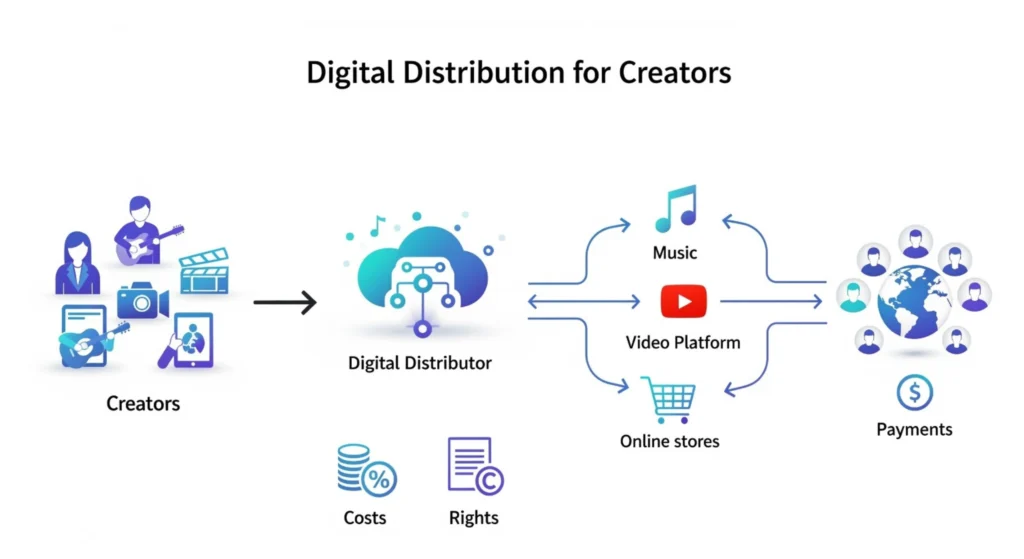
The good news is that digital distribution solutions are available to aggregate access to the various streaming channels and stores, thus giving creators a one-shot way to add their content to multiple outlets.
For example, with DistroKid you can send music tracks to the likes of Apple Music, Spotify, Tidal and more with no need to do this manually for each service. There are similarly flexible multi-release services for videos and other categories of content, so it’s just as simple to launch new projects to YouTube, Vimeo and so forth.
The Costs
Digital distribution is not free, but there are different ways to pay depending on what’s most appropriate for the content you create, the size of your audience, and the ambitions you have for growing your reach. Indeed, any remote business idea has startup costs, so it’s not unusual in this regard.
First, you’ll have the option to use distribution channels that charge a flat fee for disseminating your creations. This might be a one-off upfront payment on a per-project basis, or it might be a recurring subscription.
The advantage here is that you’ll know exactly what cut the service will take from your eventual earnings, with no nasty surprises later on. The downside is that there will be a price to pay, whether or not your releases actually generate any revenue.
Then, there’s the commission-based approach adopted by other distributors. Rather than charge anything initially, they’ll instead recoup costs from the royalties or revenues your releases generate. So in the case of a music track, a distributor may siphon off between 10% and 20% of any streaming income it makes, before paying the remainder to you.
The benefit of the commission model for creators is that you don’t need to factor in upfront or recurring costs, since you’ll only be paying the distributor if your releases make any money. If a track or video doesn’t hit the mark, you won’t be out of pocket. The drawback is that any mega-successful piece of content will have its ROI dented by the slice of the pie you have to pay to the distributor you used.
The way you go about digital distribution for creators is your own choice, and there’s no objectively correct option. Regardless, it’s a good idea to go over the terms and conditions laid out by digital distributors with a fine-toothed comb so you know exactly what to expect in terms of any costs or fees.
The Rights Issue
Another lynchpin talking point in terms of digital distribution is who owns the rights to your content.
Again, agreements with individual distributors vary, but as a rule, you’ll find that creators retain the rights to and ownership of their content even if they use a third-party distributor to share it with the world. What a distributor receives is the right to distribute content according to the terms of its service and the channels it covers.
Generally speaking, if you release a music track or video using a distributor, this won’t impede your ability to share it yourself in other contexts, or sell the rights for its use by third parties, such as for marketing purposes. There may be terms that impact how you can distribute it going forward, although these tend to be lenient, since distributors look to make money from recurring fees or commission, not through strict ownership of content rights.
It’s a good idea to read up on copyright law so that you have an understanding of your top-level rights as a creator. That way, you can tell whether a distributor is playing fair, or whether its terms are not aligned with the legal realities we are all subject to.
The Payment Process
Ideally, your content will start earning income once it has been distributed, in which case you’ll expect to receive payment for the success it has earned.
If you use a digital distribution service, it will act as the conduit for this influx of cash, and the proportion of the earnings you receive will depend on the terms of payment for the service, as discussed above.
In terms of how frequently payouts will occur, this is also variable. Some distributors are flexible, allowing you to either set a target amount to hit, at which point payment occurs automatically, or enabling you to handle this in a regularly scheduled way, every quarter or year. Others will set this in stone and send out payments regularly, regardless of how much (or how little) your content has made.
The income itself is also highly variable and depends on the platforms to which the content gets added. For music streaming services, each stream will generate a tiny slice of revenue, usually fractions of a cent, that accumulates over time before being paid back. The per-stream average is estimated to sit between $0.003 and $0.005.
For video content, platforms may pay based on view count, but may also factor in the number of ads shown during the clip, the average view duration, the target audience, and all manner of other metrics and variables. YouTube is the obvious starting point for looking into this, although there are alternatives out there worth considering.
Artists like Taylor Swift can make over $100 million annually from streams alone, so the initial numbers might seem small, but there’s no cap on the potential revenue. You need to be realistic about your own chances of success, of course, and use this to determine how you go about picking a digital distribution provider.
Final Thoughts
Digital distribution for creators puts creators in a position of power, allowing them to release content and earn money from their work without handling the mind-numbing, time-consuming parts of this process themselves.
There are a lot of variables at play and unique factors to consider when deciding on a distribution solution to adopt. However, once chosen, this can create a partnership that is lucrative and long-lasting.