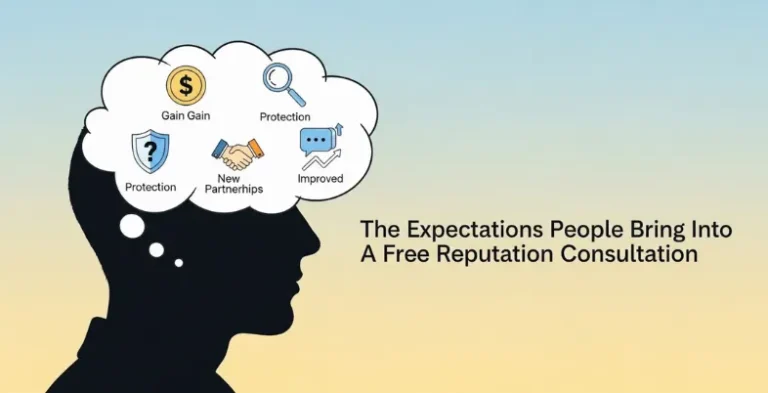
People rarely arrive at a free reputation consultation calmly. Most show up after something already gone wrong. A damaging search result appeared. Reviews slipped. A news article resurfaced. A name search stopped reflecting reality.
By the time the consultation begins, expectations are already formed. Some expect immediate fixes. Others assume the session is only a sales pitch. Many quietly hope someone will confirm the situation is easier than it looks.
The consultation works best when those expectations match what the meeting is actually designed to do: diagnose, clarify, and map a path forward.
The Misunderstanding That Starts Most Consultations
A free consultation is not implementation. It is an assessment.
That distinction sounds obvious, yet it drives most disappointment. People often assume the session itself will repair reputation issues rather than explain how it does so.
Reputation problems rarely have single-step solutions. Search engines, review platforms, and publishers operate independently. No agency controls them directly, including firms like NetReputation. What experts can control is strategy, positioning, and long-term visibility.
The consultation exists to answer three questions:
- What is actually happening online
- Why is it happening
- What can realistically change, and how long it takes
When expectations shift toward clarity instead of instant resolution, the conversation becomes far more valuable.
Expecting Immediate Fixes
Many people enter a consultation hoping that negative content disappears quickly. That expectation usually comes from misunderstanding how platforms work.
Reviews cannot be removed simply because they are perceived as unfair. Search results cannot be erased on request. News coverage rarely disappears without legal grounds.
What consultants typically outline instead:
- response strategies that reshape public perception
- content development that outranks harmful results
- monitoring systems that prevent escalation
- timelines based on platform behavior, not promises
Reputation repair operates more like rebuilding credibility than deleting information. Early progress often appears gradually through ranking shifts, improved sentiment, and stronger positive visibility.
A consultation reframes urgency into strategy.
Assuming the Consultation Is Just a Sales Pitch
Some people join expecting pressure rather than help. That assumption causes them to disengage before useful insights appear.
A strong free reputation consultation usually delivers tangible value even without a contract. Experienced firms review search visibility, identify risk areas, and explain patterns clients had not noticed.
Typical outcomes include:
- identifying which results actually influence perception
- spotting overlooked reputation risks
- clarifying whether the issue of concern is widespread or isolated
- outlining realistic options, including doing nothing when appropriate
Organizations like NetReputation rely on informed clients, not rushed decisions. The consultation works as mutual evaluation. Clients assess expertise while consultants assess solvability.
When both sides treat it as discovery, the conversation immediately changes tone.
Financial Expectations That Create Friction
Another common expectation: that reputation repair can remain free.
The consultation itself costs nothing because athe nalysis happens quickly. Execution does not. Content creation, monitoring, outreach, and strategy require ongoing work.
Confusion usually appears in two forms:
- assuming a one-time fix solves an ongoing visibility problem
- expecting pricing without understanding the scope
During a consultation, reputable advisors explain why reputation management behaves more like maintenance than repair. Search ecosystems change constantly. Competitors publish. Reviews continue. Algorithms evolve.
Costs reflect sustained effort, not a single action.
Transparency during this stage prevents frustration later.
Timeline Assumptions That Don’t Match Reality
Reputation issues feel urgent because they affect identity, business revenue, or professional credibility. That urgency often turns into unrealistic timelines.
People frequently expect visible change within weeks. Meaningful improvement typically requires months.
A consultation should clarify phases instead of promising speed:
- Early phase: audit, monitoring, response corrections
- Mid phase: creation of positive assets and authority signals
- Later phase: ranking shifts and narrative stabilization
Search engines reward consistency more than quick bursts of activity. Consultants who explain this clearly build trust faster than those offering aggressive timelines.
Progress in reputation management is measurable, but rarely instant.
Expecting Full Service From a Diagnostic Session
A free reputation consultation delivers insight, not execution.
That difference matters. The session may include a reputation overview, but it does not replace a full audit or campaign.
What is typically covered:
- visible search landscape analysis
- high-level risk identification
- priority recommendations
- strategic direction
What is usually not included:
- deep forensic investigation
- outreach to publishers
- content production
- active suppression campaigns
The goal is understanding feasibility. Not every problem requires intervention, and ethical consultants say so when appropriate.
Hoping for Complete Removal of Negative Content
Many participants enter hoping that everything negative can disappear.
Reality is more nuanced. Removal works only under specific conditions, such as policy violations, legal conflicts, or demonstrably false information.
Most reputation improvement happens through balance rather than deletion. Positive, accurate content gains visibility until harmful results lose prominence.
This distinction surprises people at first. It also reflects how search systems function. Visibility determines perception more than existence.
Consultations help clients understand which outcomes are achievable and which expectations create unnecessary frustration.
Expecting Immediate Personalization Without Context
Clients often expect highly customized strategies within minutes. Effective personalization requires information.
Consultants typically need details about:
- industry environment
- history of the issue
- existing content assets
- business goals or personal priorities
- past attempts at resolution
Without context, advice becomes generic. Strong consultations ask many questions before offering conclusions. That questioning signals professionalism, not uncertainty.
A strategy built too quickly usually ignores critical variables.
Expectations Around Expertise
People entering a consultation want reassurance that they are speaking with experts. That expectation is reasonable.
Credibility shows through specifics, not claims. Experienced consultants explain processes clearly, reference comparable situations, and openly describe limitations.
Signs of real expertise include:
- realistic outcomes instead of guarantees
- explanation of platform constraints
- structured problem analysis
- willingness to recommend alternatives
Reputation management involves judgment as much as technical skill. The consultation reveals whether that judgment exists.
What a Free Reputation Consultation Actually Provides
At its best, the consultation resets perspective.
Instead of panic, there is structure. Instead of assumptions, there is context. Instead of guessing, there is a roadmap.
People leave understanding:
- what matters online and what does not
- which problems require action
- how long realistically does improvement take?
- whether professional help makes sense at all
The value is clarity. Not persuasion.
A free reputation consultation succeeds when expectations shift from quick fixes toward informed decisions. Once that happens, the conversation stops feeling like a pitch and starts functioning as what it was meant to be: the first honest look at a reputation problem and its real path forward.