
It is difficult to manage a small non-profit or a charity. You have donors, volunteers, events, and programs to coordinate. You have to maintain a lot of people, money, and communications. When you attempt to do this using spreadsheets or paper, it quickly becomes sloppy and time-consuming. That’s where a CRM helps.
CRM is an abbreviation of Customer (or Constituent) Relationship Management. In the case of charities, it’s a system that organizes data on donors, volunteers, sponsors, events, grants, and more. A good CRM helps you streamline operations, save time, and build stronger relationships. If you’re looking for the best CRM for charities, the right platform can truly transform how you manage your mission.
- Be aware of the giver, when, and how much.
- Easily send thank you notes and reminders.
- Learn about the origins of successful donations and the campaigns behind them.
- Organize events, communications, and coordinate volunteers effectively.
A CRM is a valuable tool for creating a less stressful, easier workload and more time to focus on the actual mission.
Why Charities Need a Specialised CRM
Not all CRMs are equal. The needs of a charity and a business that sells products are different. That is why a nonprofit-friendly or specialised CRM is superior:
- Donor Tracking/ Customer Tracking: Charities do not simply desire sales figures. They desire to see the history of donors: what projects people contribute, when they did it, are they recurring or not, etc.
- Grant & Fund Management: Most charities have limited funds or grants to deal with. That is money that is allocated to certain purposes. They must monitor compliance, reporting and accountability.
- Volunteer & Event Management: Volunteers are key. Funds and awareness are raised through events. Charities require a means of recruiting volunteers, inviting/sending tickets to events, monitoring attendance, etc.
- Communication & Stewardship: Appreciating the donors, reporting to them, newsletters, segmentation (sending the appropriate message to the appropriate group). A good CRM for charity supports this.
- Reporting & Transparency: Charities are often reporting to boards, regulators or donors. They must receive concise reports, including financials, impact, donor behavior, etc.
- Cost Sensitivity & Ease of Use: Smaller charities are small in terms of budget and staffing. They are not able to afford too costly or complicated CRMs. They require something that is user friendly, fast to master and cheap or offering discounts.
You Might Like: How to Start a NonProfit
Top CRM Options for Charities & Nonprofits – Comparison Table
Here is a quick table of some CRMs:.
| Name | Best For | Key Features |
| Blackbaud Raiser’s Edge NXT | Large charities with many donors and complex fundraising | Strong donor database, wealth screening, major gifts tools, reporting, event management |
| KindLink | Most likely custom workflows, local support, and adaptable features | Easy online forms, volunteer/event management, secure data, integrations, AI for admin tasks |
| Beacon CRM | UK / international smaller charities wanting simple, secure tools | Tools for donor communication, updates, engagement metrics (assuming, in general, KindLink is known for storytelling & CSR) |
| CoreFactors | Charities needing custom‐fit processes (hypothetical: maybe local consultant/custom CRM) | Tools for donor communication, updates, engagement metrics (assuming, in general KindLink is known for storytelling & CSR) |
| Bonterra | Medium to larger orgs wanting multiple tools in one place | Multichannel fundraising, grants management, donor relations tools, flexible features |
| Zoho for Nonprofits | Small to medium NGOs wanting affordable, flexible tools | Donor & volunteer management, event tools, dashboards, email/SMS, custom forms, automation. |
| Vtiger | NGOs wanting CRM + sales/marketing style features (if they also do fundraising campaigns) | Contact management, email/SMS integrations, pipelines, perhaps automation, reports |
| Givebutter | Organisations with tight budget, wanting free / low cost, modern user experience | Free donor management core, unlimited contacts, easy online forms, receipts, segments, donor profiles etc. |
| DonorDirect | Faith-based or smaller charities wanting donation & direct stewardship tools | Tools to collect donations, track donors, send communications, perhaps volunteer/event management (specific to region) |
| Bloomerang | Small/medium charities wanting good ease of use and donor retention focus | Clean UI, donor retention tools, tracking, reporting, insights, good customer support |
10 Best CRM for Charities & Small Non-Profits
1. Blackbaud (Raiser’s Edge NXT)
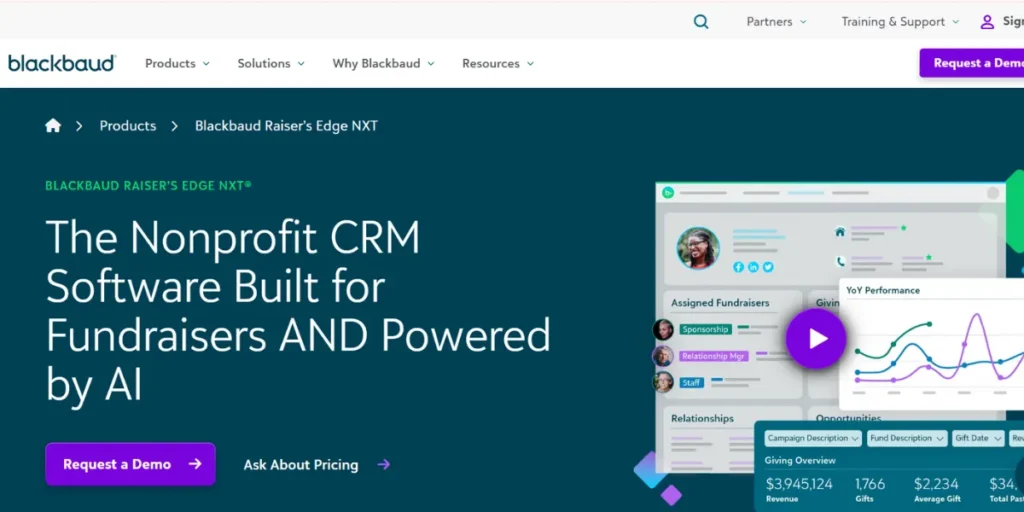
The Raiser’s Edge NXT is one of the oldest CRMs available in the nonprofit community. It works with large non-profits and charities that receive high volumes of donations, have numerous programs, and have significant gifts work. It provides the means of tracking donors, running fundraising campaigns (online and offline), comprehensive reporting and wealth screening (to identify those who may contribute more).
It facilitates event management, and incorporates events into journeys of donors. You can arrange recognition letters, promises, and regular gifts. It is also able to administer grants and restricted funds. The platform includes numerous integrations (email, payment gateways, software marketing tools), powerful dashboards, mobile access and frequently numerous add-ons or modules. If you’re looking for the best CRM for charities, the right platform can truly transform how you manage your mission.
Key Features Specialized for Charities & Small Non-Profits:
- Giving history and segmentation database of donors.
- Significant gift transactions and screening.
- Budgeting of grants and restricted funds.
- Organizing events and combining offline/online marketing.
- Detailed reporting and dashboards.
- Reoccurring gift / pledge management.
Pros:
- Extremely strong and feature rich.
- In-depth reporting and insights.
- Ideal with big donor books and complicated fundraising.
- Good reputation and solid company.
Cons:
- Expensive (more difficult with small orgs)
- Difficult to learn, requires a lot of training.
- Most of the more advanced features can be excessive when you are small.
- Set up time and customisation can be lengthy.
Best For: Medium and large charities or smaller charities that intend to expand rapidly; charities that have funds to invest in training and customization.
Website Link: https://www.blackbaud.com/products/blackbaud-raisers-edge-nxt
2. KindLink
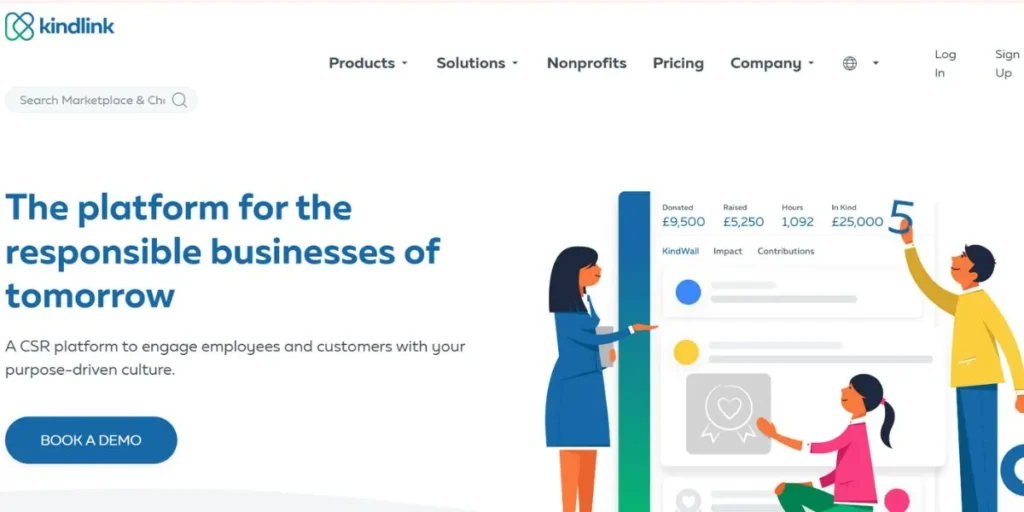
KindLink is a platform that focuses on connecting impactful donors. It allows charities to tell good stories, update, demonstrate impact using measures and visuals. It also facilitates fundraising, donor connection and CSR (corporate social responsibility) connections. Organizations are able to design campaigns, keep the followers updated, monitor the engagements of followers.
The interface is simplistic and focuses on openness. It can include online giving tools, donor portals, impact report generation, volunteer management. It assists donors in the understanding of the flow of money, which fosters trust. In the case of smaller charities, this assists in demonstrating credibility. It probably involves sharing through social media, perhaps donor communication tools (email). If you’re looking for the best CRM for charities, the right platform can truly transform how you manage your mission.
Key Features Specialized for Charitable and Non-Profit Specialized:
- Campaign pages + impact visuals.
- Donor engagement & updates
- Basic fundraising tools
- Open communication to donors / stakeholders.
- Capacity to present impact measurements.
Pros:
- Good at developing trust with donors.
- Well told stories and user experience.
- Easier to learn & use
- Small impact organizations can afford it.
Cons:
- Many are not deep-granted or accounted for.
- Not as appropriate to gigantic donor books.
- May requires other tools to be fully functional.
Best For: Small charities that have a high need to demonstrate impact and attract donors, maybe in the education sector, environment, community service, etc.
Website Link: https://www.kindlink.com/
3. Beacon CRM
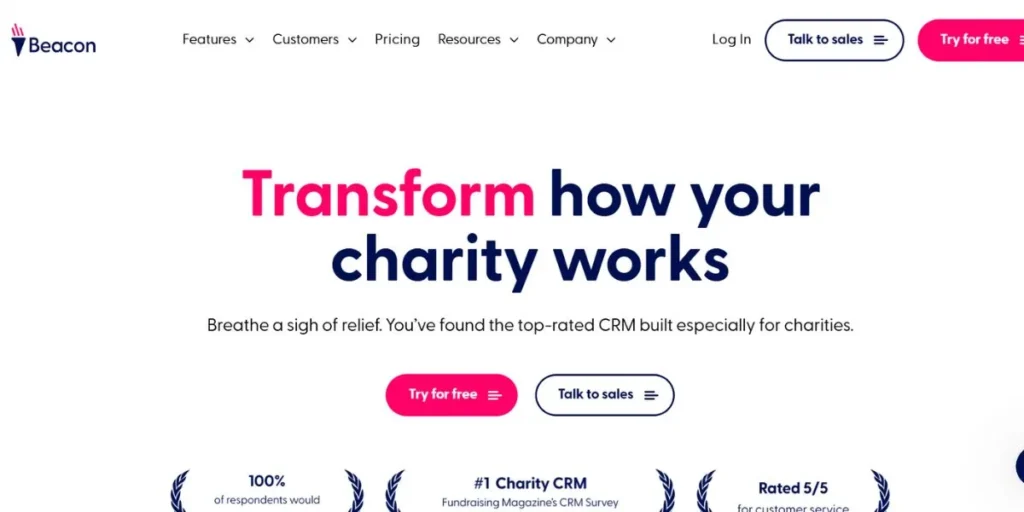
Beacon CRM is designed to target UK/international non-profits desiring modern, secure tools but not excessively complex. It has online form features (to take donations, volunteer registration, event registration), email, payment gateway integration, basic event/ticket management. It has good security credentials (e.g. ISO certification). It also attempts to minimize the work of the administration through features that automatize repetitive work.
As an example, it can have AI to assist with routine administration. Beacon probably has dashboards and reporting where you can view the trends of donors, donations over time, campaign performance. It has volunteer management integrations. The design tends to be simple, user friendly and targeted at non-technical people. Support is generally good. Its best CRM for charities empowering nausea.
Key Features Specialized for Charitable and Non-Profit Specialized:
- Donation, volunteer, events Secure data (certification) Online forms.
- Robots to cut down on administration.
- Reports and dashboards of donations/campaign trends.
- Volunteer/event signup management.
Pros:
- Good security, peace of mind.
- Clean, intuitive design
- Well-rounded capabilities on the necessities, without overwhelming small teams.
- Helpful support
Cons:
- May need add-ons or integrations to have advanced features.
- The availability of payment gateway may depend on the country.
- Not as well adapted to large donor bases or extremely complicated accounting requirements.
Best For: Small to medium charities, which require good security and strong basics, do not desire super complex systems.
Website Link: https://www.beaconcrm.org/
4. Corefactors
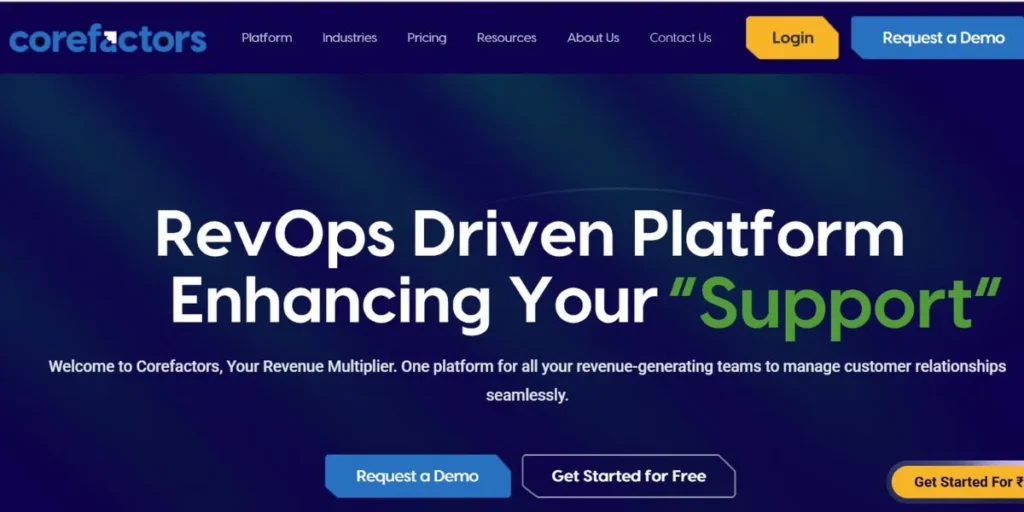
The concept of Corefactors is not as well known in the world, but the concept is a CRM or a consultancy + CRM package that is more personalised. In the case of charities, this type of tool implies that your processes can be customized: the way you receive donations, the way you process volunteer requests, the way you send thank-you letters or donor follow ups. They can provide local or regional assistance, fit in with your legal / tax / donation regulations in your country.
Frequently, these CRMs offer a greater custom field and custom report control, and local payment gateway integration. The disadvantage is that it may require more time to establish and it may be more expensive to do so initially. However, when it is installed, it can be just what you require. The best CRM for Charities that know what they want, or have someone technical or someone who can handle configurations, are good.
Key Features Specialized for Charitable and Non-Profit Specialized:
- Custom workflows & fields
- Local currency support / local payment gateway.
- Donor / volunteer management
- Individualized reports and dashboards.
- Communication integration.
Pros:
- Made according to your needs
- As you grow or change programs are flexible.
- Perhaps closer conformity to local rules and customs.
Cons:
- Greater time to set up / configure.
- Possibly increased initial price or technical assistance.
- Unless the vendor is good, there is the risk of bad support/delays.
Best For: Organizations with a bit of ability to handle technical setup, those that desire something special over off-the-shelf.
Website Link: https://www.corefactors.ai/
Read my next Blog: Client and Customer Portal Software
5. Bonterra
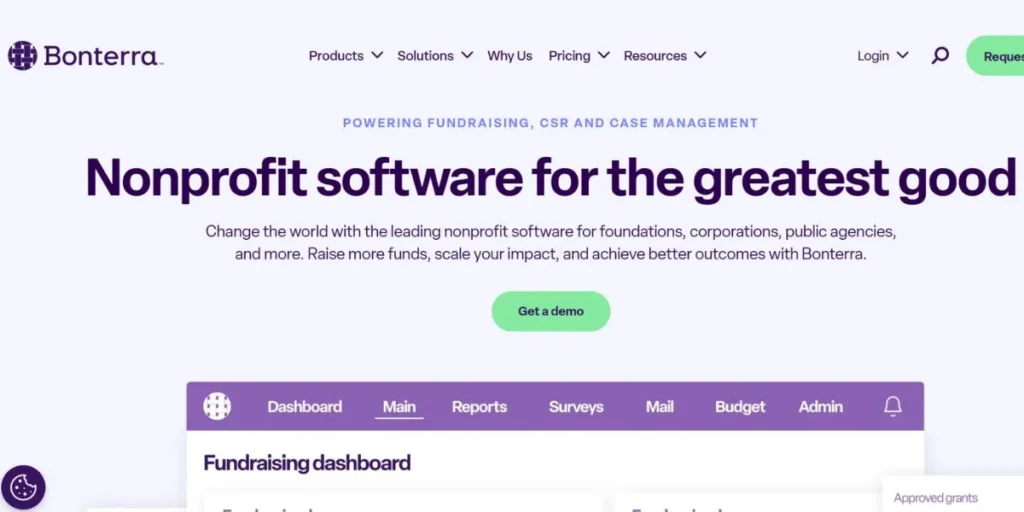
One platform, Bonterra, is a platform that unites numerous tools of nonprofits under a single roof. It possesses excellent fundraising, grants management, donor engagement and multichannel communication. It seeks to allow you to do email, events, asks and follow ups in an integrated manner. Bonterra can help you to have fewer systems when you do not need dozens of separate tools.
It also promotes current donor behaviour: recurring donation, matching donation, online campaigns.Best CRM for Charities. Due to the ownership or aggregation of a variety of smaller technology nonprofit companies, the breadth of tools is wide. On the other hand, it is hard to control all those tools and that is why sometimes the platform may seem big, or the features are getting modified, or the support may be different.
Key Features Specialized for Charitable and Non-Profit Specialized:
- Combined fundraising + grant management.
- Multichannel (email, digital, offline) communication.
- Donor involvement and, perhaps, matching gift solutions.
- Recurring gifts / pledges
- Reporting and metrics
Pros:
- Lots of features in one place
- Scalable in nature.
- Saves on having to use numerous apps.
Cons:
- When many modules are used it can be more expensive.
- Complexity and learning curve.
- There are some features that can be unnecessary or unused should you not require them all.
Best For: Nonprofits (that are medium-sized or intend to expand) and need to consolidate a large number of tools, minimize integrations.
Website Link: https://www.bonterratech.com/
6. Zoho for Nonprofits
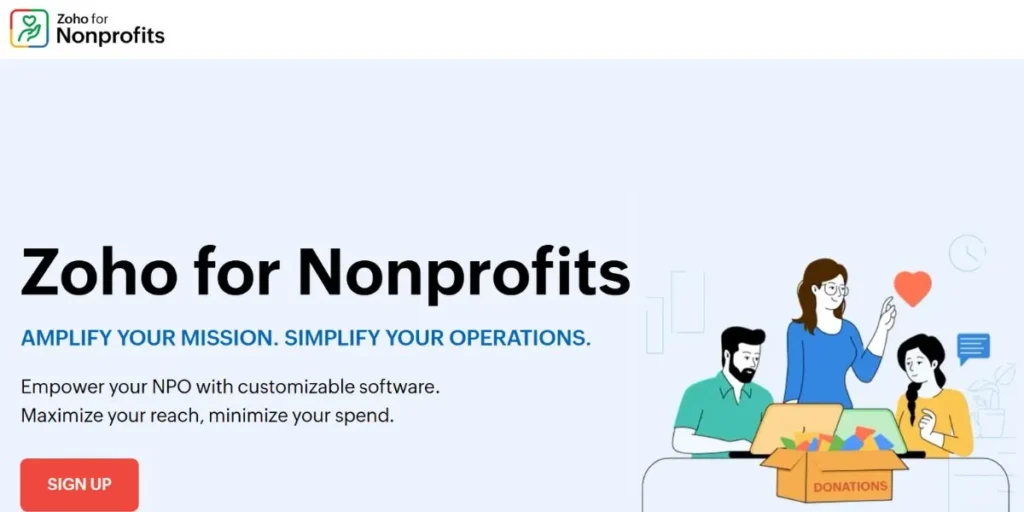
Zoho has a series of tools that are quite user-friendly to nonprofits. Their Zoho Nonprofits features allow small and medium non-governmental organizations to automate their routine operations, donor management, volunteer management, event management, campaign management. You are able to send bulk emails/SMS, create custom forms, donor/contributor dashboards, volunteer profiles.
They also provide you with flexibility with custom fields and workflows- so you can only use what you need. Zoho tends to provide nonprofits with discounts. As a large company, there is a broad ecosystem: in the future, when you desire an improved accounting, or more analytics, or a connection with other Zoho products, it is fine. On the other hand, there are features that are more advanced and they need knowledge or upgrading.
Key Features Specialized for Charitable and Non-Profit Specialized:
- Donor profile management
- Volunteer profile management
- Personalized forms and questionnaires / invitations to events.
- Campaign, donor, volunteer dashboards.
- Mass email/SMS and automation to save on duplication.
- Connection to payment gateways and third party tools.
Pros:
- Affordable and flexible
- Lots of characteristics in a single ecosystem.
- Nonprofits get good discounts in most countries.
Cons:
- Occasionally require technical assistance with custom workflow.
- Other features are not so specialised to charities (grant compliance, restricted funds).
- Quality of support and documentation can be different depending on the region.
Best For: Grassroots charities, small to medium non-profits, seek good features at a low cost, perhaps low maintenance.
Website Link: https://www.zoho.com/nonprofits/
7. Vtiger
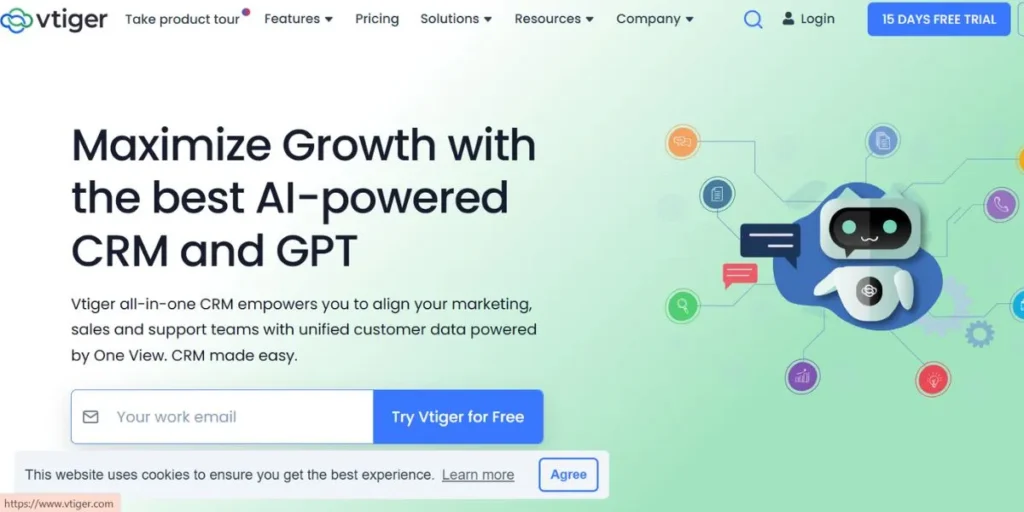
Vtiger is a CRM commonly utilized in sales or business, however, it can be modified to suit nonprofits. It contains contact management, pipelines, email integration, task automation, reports. In a charity with numerous fundraising campaigns that seem like sales pipelines (e.g. grant proposals, event fundraising, donor asks), Vtiger can assist you in keeping track of which asks are open, which proposals were responded to, etc. You may utilize custom fields, tags, reminders.
It can have donor mapping modules or extensions, payment gateway integration, and volunteer registration. It may lack all the nonprofit-specific functionality by default (particularly limited funds, or highly customized grant management). As well, support / pricing is based on the number of users and modules. If you’re exploring the best CRMs for charities, Vtiger can be a practical choice for many organizations.
Key Features Specialized for Charitable and Non-Profit Specialized:
- Contact and donor management with custom fields/tags.
- Fundraising asks Campaign/pipeline tracking.
- Task & reminder automation
- Email/SMS, reporting.
- Capability to combine with payment systems or other applications.
Pros:
- Adjustable, numerous features.
- Not fixed on nonprofit pricing; can be cheaper based on modules.
- Familiarity can be experienced by individuals who have used business CRMs.
Cons:
- Must be customized or changed, and this is hard.
- May does not have extensive nonprofit-specific capabilities such as limited fund tracking.
- Add-ons/modules cost extra
Best For: Charities seeking this flexibility; perhaps those with people who are comfortable with technology or whose fundraising.
Website Link: https://www.vtiger.com/
8. Givebutter
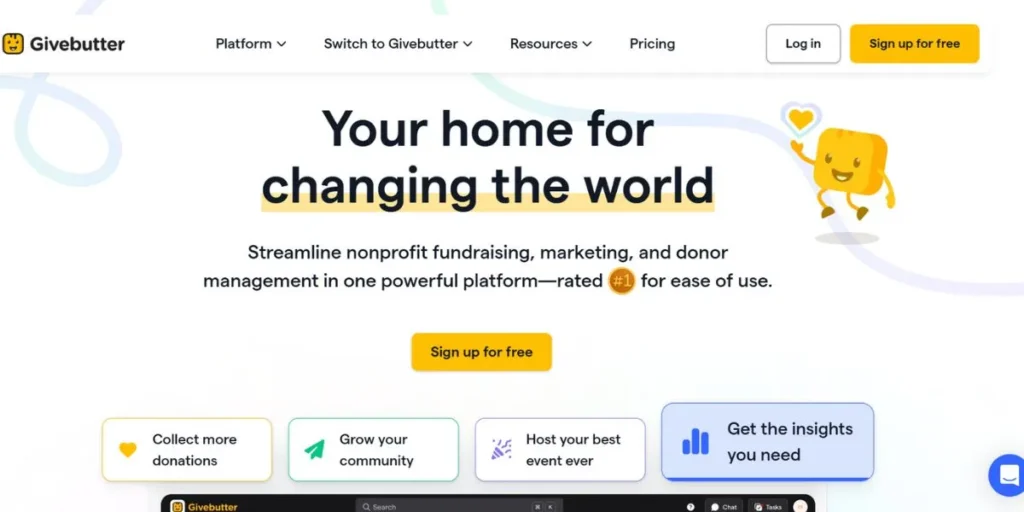
Givebutter is contemporary, non-profit, and particularly pleasant in terms of small organizations or those with limited funds. It offers a free core donor management / CRM system: you can store an unlimited number of contacts, donations (including offline ones), send receipts, filter donors, custom fields/tags, segments and see giving summaries. It also allows online form, event tickets, and communication software. The dashboard is friendly.
There are paid levels in case of advanced functionality (automation, workflows). It is friendly to those who are not techno-savvy. Givebutter offers a lot with low barriers, in case you do not need something very complex. Conversely, scaling up or very customised reports or limited fund tracking may be limited when you need a very customised report. Advanced levels are also expensive. If you’re exploring the best CRM for charities, Vtiger can be a practical choice for many organizations.
Key Features Specialized for Charitable and Non-Profit Specialized:
- Free donor management core, and unlimited contacts.
- Custom fields, tags, filters and segments to organise donors.
- Online event ticketing, online donation forms.
- Capacity to process offline donations and give receipts.
- Friendly interface, simple importation, live search, donor profiles etc.
Pros:
- Excellent prices on a small budget.
- Intuitive, simple to enter.
- Helps minimize the use of spreadsheets.
Cons:
- High levels of customization / complex grant tracking can be restricted.
- Complex workflows are more expensive.
- May may require the strength of the payment gateways / local support in your area.
Best For: Minute charities; grassroots NGOs; those that desire something to work fast and cheap; pilot projects or preliminary.
Website Link: https://givebutter.com/
9. DonorDirect
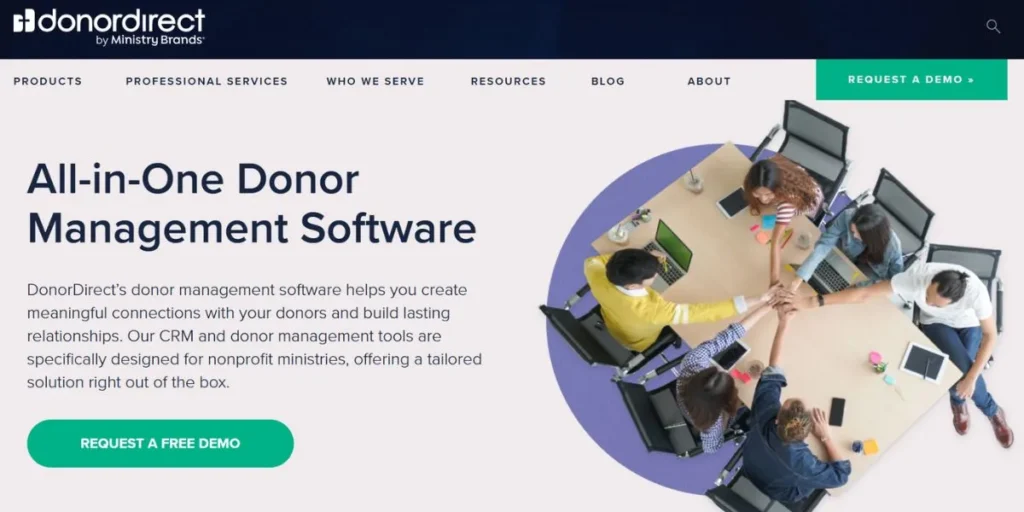
DonorDirect is a CRM / donor management system (commonly used by faith-based organisations, charities), which is oriented around direct giving, stewardship and communication. It probably has donation tracking, donor history, may have email communication, event or volunteer tracking. It can also facilitate offline contributions and follow ups.
It is not as advanced as such giants as Blackbaud, which is why it is easier to learn and cheaper. In the case of small or medium charities that do a lot of direct giving (churches, small community charities, etc.), DonorDirect may suffice. It may not have fancy reporting dashboards, or advanced campaign management or limited fund accounting; integrations may be fewer, and support may be more expensive, some cons. If you’re exploring the best CRM for charities, Vtiger can be a practical choice for many organizations.
Key Features Specialized for Charitable and Non-Profit Specialized:
- Tracking of donations and donor history.
- Communications (thank you letters, follow ups)
- Simple event / volunteer registration possibly (by package)
- Offline donations management.
Pros:
- Easier learning curve
- More affordable
- More focused on essentials
Cons:
- Less advanced features
- May lack good automation
- Analytics Reporting may be weaker.
- May needs more tools to perform additional functions.
Best For: Small charities, faith-based organisations, community organisations which do not require large grant management or large donor books.
Website Link: https://www.donordirect.com/
10. Bloomerang
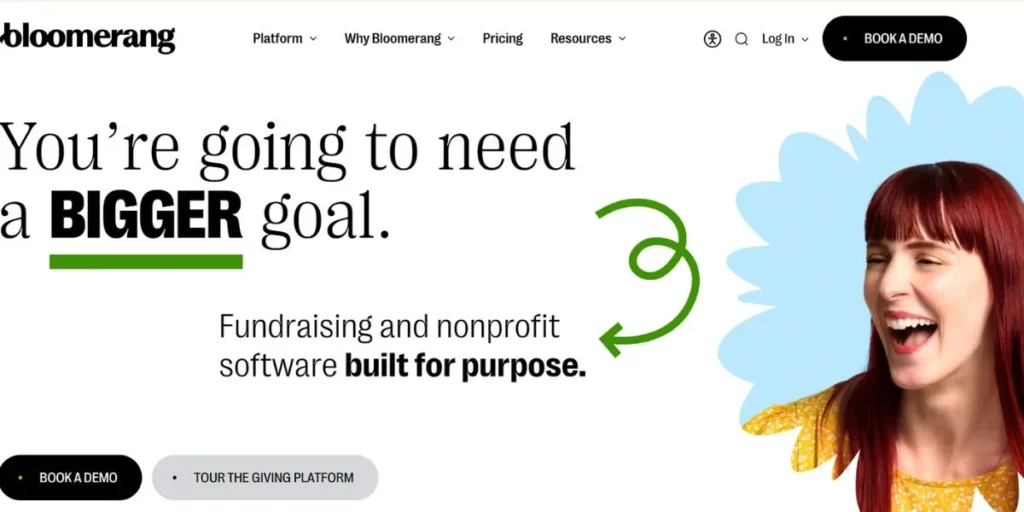
Bloomerang is designed to meet the needs of nonprofits, particularly those that are interested in donor retention and ease. It provides the means to monitor the history of giving, donor interactions, sending thank you letters, emailing, dashboards to view retention, donor loyalty, segments (new, lapsed, recurring donors). It attempts to simplify things so that it becomes easy to view how many donors contributed last year and not this year, who are my top donors etc.
The interface is clear, useful, and user-friendly. It has decent support. It can also possess event tools, yet the good one is communication, donor experience and retention. The disadvantage is that you might have to integrate or upgrade in case you require numerous sophisticated modules (pricey event auctions, membership, grant tracking, restricted funds). Other reports are less customisable or fixed. If you’re exploring the best CRM for charities, Vtiger can be a practical choice for many organizations.
Key Features Specialized for Charitable and Non-Profit:
- Retention tools and analytics of donors.
- Trends and segments of donors to view on clean dashboards.
- Proper emailing, templates, thank you processes.
- Easy to use, good support
Pros:
- User friendly, clear UI
- Concentrate on retention, rather than acquisition.
- Lower overhead for training
Cons:
- Weaker in very large / complex systems.
- Report customisation can be restricted.
- Other features that are not related to donor retention can be more expensive.
Best For: Small to medium nonprofits that rely on recurring donors, desire good donor care, not so much big events or large grants management.
Website Link: https://bloomerang.com/
Potential Risks / Things to Watch Out
In choosing or implementing a CRM, the following are some of the pitfalls to be avoided or consider:
- Lock-in or Vendor Dependence: You can get stuck in case your data is stored in a format that is difficult to export or transfer. Always ensure that it is easy to export data or switch to another system.
- Hidden Costs: Other CRMs claim to be low price and then offer additional modules, additional users, additional storage, additional emails, premium support. Total cost of ownership (set up, training, maintenance, upgrades) budget.
- Over-Complexity: Small teams are overwhelmed by big CRMs. Excessive features that are not utilised by anyone can consume time and resources and complicate matters.
- Weak Local Support/Payment Gateway Problems: In the case of foreign CRM, it might not accommodate local regulations (tax, rules on donations), methods of paying donors, and currency. The support can be poor or slow.
- Data Privacy / Security Risks: Donor data is personal. Without a good security (encryption, backups, secure access) of the CRM, you will risk leak or loss of trust.
- Scalability & Future Needs: Select something that will work today and tomorrow. It’s painful to switch later. But also do not spend money on features which you will not need in the near future.
Conclusion & Recommendation
Best CRMs for charities are quite useful to small non-profits and charities. They save time, minimize errors, enhance donor relations, and assist you in knowing what works.
No one fits all. It is based on what you require at present, what you intend to do in future, amount of money/manpower available and the complexity of your fundraising or programs.
Begin with a smaller, nonprofit-friendly CRM. A Givebutter or Zoho Nonprofit or Beacon or Bloomerang, etc. Have your core donor tracking operational, develop good donor stewardship and understand what reports/metrics you really need. After considering these options, you can explore the possibility of upgrading to more advanced solutions such as Blackbaud or Bonterra.
Had I been you, with a little charity, I would lean towards Givebutter or Zoho (since they do a lot without going too far or too much bother), perhaps Beacon should I like their fashion and their safety. As you grow, re-assess.
FAQs
Should we have a CRM at the beginning, or can we postpone?
You might begin with spreadsheets when you are very small. But postponements magnify things. The sooner you have regular records the easier it is to scale. Then begin small, with a simple CRM.
What is the cost of a nonprofit CRM?
It varies a lot. Other CRMs have free or cheap levels. Some are hundreds or thousands of dollars per year, depending on the number of donors, features, and users. Allot funds to additional training, integration, and support.
Is it possible to utilize a normal business CRM rather than nonprofit?
Yes, but you will not get donor-specific features (restricted funds, grant tracking, donor stewardship, nonprofit reports). Also cost & workflows might not be perfect. When you find a business CRM that works, you can adapt it, but CRMs that are friendly to nonprofits can save you the trouble.
What are the initial steps towards successful adoption of a CRM?
Clean up your data (clean up, remove duplicates, organise fields). Make your choice as to what you really need. Train the team. Start with a pilot. Set simple workflows. Apply what you get to know to get better.
