
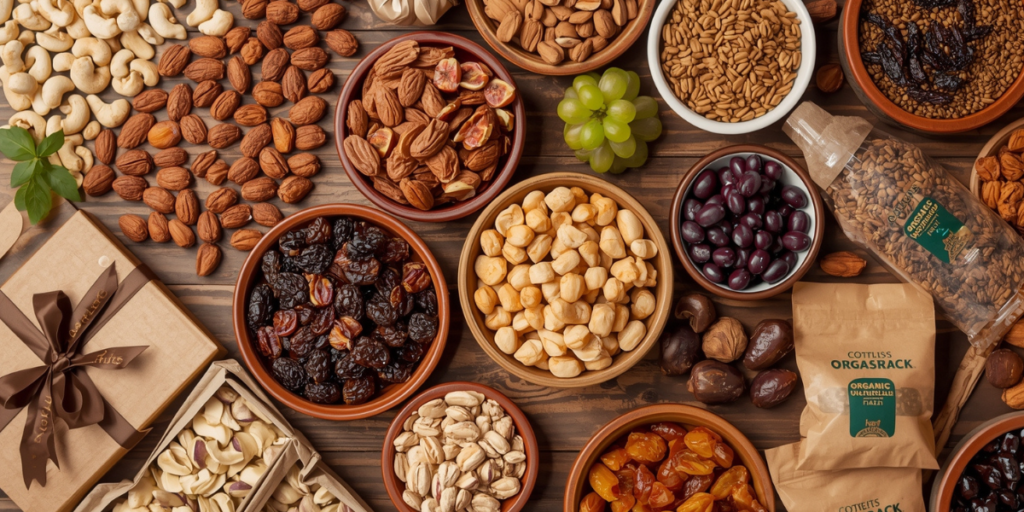
The year 2026 would be an excellent time for an entrepreneur how to start dry fruit business in India, as it will open the door for a profitable venture with the vast potential to grow. India’s dried fruit market is witnessing the fastest growth ever, driven by rising health awareness, higher incomes, and the tradition of gifting premium nuts and dried fruits during festivals and other occasions.
No matter what business model you choose, be it home-based, e-commerce or wholesale distribution, you will have to go through strategic planning and market knowledge to learn how to start a dry fruit business. This all-inclusive and detailed guide leads you to every crucial point—from recognising the most profitable niches, getting quality products, to legal requirements, and scaling up your business—so that you are totally ready to set up a prosperous dry fruit business in the health food market of India, which is booming.
Why Start a Dry Fruit Business in India?

India’s dry fruit market is expected to grow significantly, driven by wellness trends and gifting traditions. Nutritious snacking options have become the preference of the majority of consumers, which, in turn, has made almonds, cashews, walnuts, and exotic dried fruits very popular.
The trade offers enticing profit margins of 20-40%, very little perishability compared to fresh fruits, and multiple channels for selling, such as retail, wholesale, online, and corporate gifting, which all contribute to the business. The dry fruit industry thus enables profitability while meeting growing demand across urban and rural India, thanks to its low entry barriers for home-based models and scalability for export markets.
Types of Dry Fruit Business Models
Home-based retail / online store
This business model is suitable for novices with small budgets. It involves selling dry fruits in bulk via social media, WhatsApp, or your own website. You can sell small, test product quality, build customer relationships face-to-face, and work from home with low overheads while slowly but surely expanding your customer base.
Wholesale supply/distribution
This model is committed to large buying and selling of dry fruits to retailers, food shops, supermarkets, and hotels. It requires a higher investment and proper storage, but it also offers high profits based on the volume sold. Being on good terms with your suppliers and having a competent transportation system are the keys to success in wholesale trade.
Online / e-commerce model
By using sites like Amazon, Flipkart, or your own online store, you can sell to customers all over the country. This strategy relies on digital marketing, high-quality product photography, competitive pricing, and reliable delivery networks. It opens new markets without physical-store constraints and provides access to data-driven consumer insights.
Value-added products & packaging
Enhance the product range by offering mixed dry fruit packs, gift hampers, roasted nuts in different flavours, trail mixes, or luxury gift boxes. This way of selling is priced higher due to the company’s branding, and it also attracts consumers seeking health and quality products who are willing to pay a bit more for convenience and aesthetic packaging.
Export or bulk-supply model
Sell to the world or the big institutional clients like food processing companies, airlines, and hotels. It is a very costly and risky undertaking, as the seller must comply with quality certification requirements and obtain export licenses while adhering to international standards. On the other hand, it does pay off in terms of securing a high price and getting long-term contracts, but it also requires being a high-quality product and complying with regulations.
Step-by-Step Guide to Start a Dry Fruit Business
Step 1: Market Research & Choosing Your Niche
Investigate demand in your area, understand your competitors’ pricing, identify your target customer group, and then identify gaps—whether organic products, budget-friendly options, premium imports, or festival-specific hampers — to give your business a unique position.
- Organic dry fruits – for health-conscious consumers.
- Budget-friendly packs – for price-sensitive buyers.
- Premium imported dry fruits – for luxury segments.
- Festival hampers – for seasonal gifting.
Step 2: Select Your Product Range (Top 3–10 Dry Fruits)
Select the most-liked products, such as almonds, cashews, walnuts, pistachios, raisins, dates, dried figs, and apricots. Initially, consider 5-7 varieties based on demand, profit, and supplier defiance. Check:
- Profitability: Some dry fruits, such as cashews and pistachios, have higher margins but require careful storage.
- Supplier availability: Ensure your chosen dry fruits are readily available from wholesalers or farmers.
Step 3: Business Plan + Cost & Profit Estimation
Make comprehensive forecasts that include the initial investment, operating expenses, pricing policy, sales targets, break-even analysis, and a map of the first 2-3 years’ growth of the business.
Basic Cost Example:
| Category | Details | Estimated Cost (INR) |
|---|---|---|
| Initial Investment | Shop rent, interior, equipment, stock | ₹3,50,000 – ₹7,50,000 |
| Monthly Expenses | Staff, utilities, logistics, misc. | ₹28,000 – ₹85,000 |
| Revenue | Selling 200–500 kg at ₹800–1,500/kg | ₹1,60,000 – ₹7,50,000 |
| Estimated Profit | Revenue – Expenses | ₹1,32,000 – ₹6,65,000 |
| Break-even | Months to recover initial investment | 6–12 months |
Step 4: Legal Requirements in India (FSSAI, GST, Trade License)
Get licenses that are required by law, including FSSAI registration for food business, GST registration for tax compliance, shop/trade license from local authorities, and business entity registration if forming a company.
- FSSAI registration: Mandatory for all food businesses in India.
- GST registration: Required if your turnover exceeds ₹40 lakh (₹20 lakh for some states) to comply with taxation.
- Shop/Trade License: Issued by the municipal authorities for operating a commercial establishment.
- Business registration: Register as a sole proprietorship, partnership, or private limited company for legal recognition.
- Other certifications: Optional certifications for organic or premium dry fruits can add credibility.
Step 5: Supplier Sourcing & Quality Checks
Find reliable wholesalers in Delhi, Mumbai, or agricultural markets. Meet suppliers face to face, verify quality certifications, negotiate prices, and create a list of alternative sources to ensure uninterrupted supply.
Step 6: Packaging, Branding & Labelling Rules
Create visually appealing, food-safe packaging with essential labelling that includes the brand name, contents, nutritional info, FSSAI number, manufacturing date, expiry date, net weight, and allergen warnings.
Step 7: Storage & Inventory Setup
Get cool, dry storage with ventilation, humidity control, and pest management. Store in airtight containers, follow FIFO inventory rotation, and keep the area clean to maintain freshness and quality.
Legal Requirements & Licenses
Essential Licenses and Registrations:
- FSSAI License: This is obligatory for all food-related businesses, and it is segmented into three categories: Basic (with a total sales of less than ₹12 lakhs), State (with a half-yearly sales of ₹12 lakhs to ₹20 crores), and Central (with sales of more than ₹20 crores)
- GST Registration: This is needed in case sales in a year are over ₹40 lakhs (or ₹20 lakhs for special category states); this allows issuing invoices legally and claiming input tax credit
- Trade License: This is a requirement for the operating company from the local municipal authority in your area
- Shop & Establishment Act: This is a registration that encompasses employee working hours, wages, and welfare provisions
- PAN Card: This is needed for business transactions, banking, and GST registration
- Import Export Code (IEC): This is non-negotiable if importing dry fruits from global suppliers
- Company/Firm Registration: LLP, Private Limited, or Proprietorship registration based on the size of the business
- Bank Account: An exclusive current account in the name of the business for financial transactions
- Weight & Measures License: Required under the Legal Metrology Act for enterprises dealing with packaged commodities.
| License/Registration | Purpose | Issuing Authority | Approx. Cost | Validity |
| FSSAI Basic Registration | Small-scale food business | FSSAI | ₹100 | 1-5 years |
| FSSAI State License | Medium-scale operations | State FSSAI Office | ₹2,000-3,000 | 1-5 years |
| FSSAI Central License | Large-scale/multi-state operations | Central FSSAI | ₹7,500 | 1-5 years |
| GST Registration | Tax compliance | GST Department | Free | Lifetime (annual returns) |
| Trade License | Business operation permission | Municipal Corporation | ₹500-2,000 | 1 year (renewable) |
| Shop & Establishment Act | Employee welfare | Labour Department | ₹1,000-5,000 | Varies by state |
| Import Export Code (IEC) | Importing dry fruits | DGFT | ₹500 (online) | Lifetime |
| Company Registration | Legal business entity | MCA (Registrar of Companies) | ₹5,000-15,000 | Lifetime |
| Legal Metrology Registration | Packaged commodity selling | Controller of Legal Metrology | ₹2,000-5,000 | 2 years |
Investment & Setup — What it Costs (From Home to Wholesale)
Cost Components Breakdown:
- Initial Stock/Inventory: This is the main expense, covering the purchase of dry fruits from wholesalers; it depends on the size of the business and the range of products offered.
- Packaging Materials: The list includes pouches, boxes, containers, labels, sealing machines, and branding materials, all of which are food-grade and safe to use.
- Licenses & Registrations: Costs for FSSAI, GST, trade licenses, and legal compliance, comprising both one-time and recurring items
- Infrastructure Setup: Rent deposits, storage racks, cooling (if needed), weighing scales, and basic furniture
- Marketing & Branding: Activities such as website development, social media marketing, printed materials, product photography, and launch campaigns will contribute to marketing and branding costs.
- Equipment & Tools: needed are weighing machines, sealing machines, packaging tools, storage containers, and hygiene supplies
- Working Capital: It will be a cushion for operational expenses, salaries, utilities, transportation, and unanticipated costs for 2-3 months.
- Technology: payment gateway charges, e-commerce platform fees, inventory management software, and point of sale systems.
| Business Model | Initial Investment | Infrastructure Costs | Inventory Costs | License & Legal | Marketing | Equipment | Working Capital |
| Home-based / Small Online | ₹25,000 – 75,000 | ₹0 – 5,000 (home space) | ₹15,000 – 40,000 | ₹2,000 – 5,000 | ₹5,000 – 15,000 | ₹3,000 – 8,000 | ₹5,000 – 10,000 |
| Small Retail Shop | ₹1,50,000 – 4,00,000 | ₹50,000 – 1,50,000 (rent + setup) | ₹50,000 – 1,50,000 | ₹5,000 – 10,000 | ₹15,000 – 40,000 | ₹10,000 – 25,000 | ₹30,000 – 50,000 |
| Wholesale Distribution | ₹5,00,000 – 15,00,000 | ₹1,50,000 – 4,00,000 (warehouse) | ₹2,50,000 – 8,00,000 | ₹10,000 – 20,000 | ₹30,000 – 80,000 | ₹50,000 – 1,50,000 | ₹50,000 – 1,80,000 |
| E-commerce Platform | ₹50,000 – 2,00,000 | ₹5,000 – 20,000 (storage space) | ₹20,000 – 80,000 | ₹3,000 – 8,000 | ₹15,000 – 50,000 | ₹5,000 – 20,000 | ₹10,000 – 30,000 |
| Premium Gift Hamper Business | ₹75,000 – 2,50,000 | ₹10,000 – 40,000 | ₹30,000 – 1,00,000 | ₹5,000 – 10,000 | ₹20,000 – 60,000 | ₹8,000 – 25,000 | ₹10,000 – 25,000 |
Monthly Recurring Costs:
| Expense Category | Home-based | Small Retail | Wholesale | E-commerce |
| Rent/Lease | ₹0 | ₹8,000 – 25,000 | ₹25,000 – 80,000 | ₹3,000 – 10,000 |
| Utilities (Electricity, Water) | ₹500 – 1,500 | ₹2,000 – 5,000 | ₹8,000 – 20,000 | ₹1,000 – 3,000 |
| Staff Salaries | ₹0 | ₹10,000 – 30,000 | ₹40,000 – 1,20,000 | ₹8,000 – 25,000 |
| Transportation/Delivery | ₹1,000 – 3,000 | ₹3,000 – 8,000 | ₹15,000 – 50,000 | ₹5,000 – 20,000 |
| Marketing & Ads | ₹2,000 – 8,000 | ₹5,000 – 15,000 | ₹10,000 – 30,000 | ₹8,000 – 30,000 |
| Packaging Materials | ₹2,000 – 5,000 | ₹5,000 – 15,000 | ₹20,000 – 60,000 | ₹4,000 – 12,000 |
| Miscellaneous | ₹1,000 – 2,000 | ₹3,000 – 8,000 | ₹8,000 – 20,000 | ₹2,000 – 5,000 |
| Total Monthly Cost | ₹6,500 – 19,500 | ₹36,000 – 1,06,000 | ₹1,26,000 – 3,80,000 | ₹31,000 – 1,05,000 |
Profitability & Profit Margins — What You Can Expect
The dry fruit business offers an excellent return on investment, as retail margins are usually 25-40%, while wholesale margins are 15-25%. The very high-end imported varieties and gift hampers, which are examples of value-added products, are sold with a 40-60% markup. A small home-based business can earn between ₹50,000 and ₹1,50,000 every month, out of which ₹15,000-45,000 will be the net profit.
Established retail shops can sell around ₹2-8 lakhs a month, with a 20-30% profit. Wholesale distributors dealing with large volumes can have monthly sales of ₹10-30 lakhs. Suppliers, inventory management, seasonal demand, and excellent cost control across all areas, including procurement, storage, and operations, will determine profitability.
Read More: Restaurant Name Ideas
Compliance & Hygiene — Food Safety, Labelling & Packaging
- FSSAI Compliance: A valid FSSAI license must be maintained and displayed prominently at all times. The permit must also be renewed before it expires, and food safety standards must be strictly adhered to.
- Hygiene Protocols: Areas for storage must be clean; pest control measures must be applied; staff must be trained in hygiene; regular sanitisation must be performed; and products must be stored at controlled temperatures.
- Packaging Standards: Food-grade materials must be used, the seal must be airtight, moisture and contamination must be protected against, and the product must be kept fresh.
- Labelling Requirements: Business name, ingredients list, nutritional information, FSSAI number, batch/lot number, manufacturing/packing date, best-before date, net quantity, price (MRP), manufacturer/packer address, country of origin, allergen information, and customer care details must be included.
- Quality Control: Regular testing for moisture content, visual inspection for discolouration or foreign particles, proper storage rotation (FIFO method), and quality documentation must be maintained.
- Documentation: Purchase invoices, supplier quality certificates, batch records, dispatch registers, and complaint registers must be retained for traceability and audit purposes.
Dry Fruit Business Ideas to Stand Out
| Business Idea | Target Audience | USP/Differentiation |
| Organic & Certified Dry Fruits | Health-conscious consumers, premium buyers | Chemical-free, certified organic, traceable sourcing |
| Festival & Corporate Gift Hampers | Corporate clients, festival shoppers | Customised packaging, bulk orders, personalised branding |
| Roasted & Flavoured Nuts | Young professionals, snack lovers | Innovative flavours (peri-peri, honey-glazed, masala) |
| Subscription Boxes | Busy families, health enthusiasts | Monthly delivery, curated mixes, and convenience |
| Diabetic-Friendly Mixed Packs | Diabetic patients, health stores | Low glycemic options, doctor-recommended mixes |
| Trail Mix & Fitness Packs | Gym-goers, athletes, hikers | High-protein, energy-boosting, portion-controlled |
| Premium Imported Varieties | Affluent customers, gourmet stores | Exotic options (Turkish apricots, California almonds) |
| Ayurvedic Dry Fruit Mixes | Wellness seekers, traditional medicine followers | Customised for immunity, energy, and brain health |
Conclusion
Learning how to start a dry fruit business in India is not only about cultivating dried fruits, but also about opening a window to a profitable, eco-friendly business in the most vibrant health food sector. The year 2025 is an excellent time for dreamers to solidify their plans, thanks to consumers’ heightened awareness of nutrition, the rise of gift-giving culture, and online shopping trends poised to reach their peak.
Whether starting a small home-based operation or planning the distribution of wholesale goods on a large scale, the path to success lies in high product quality, competitive pricing, and excellent customer service. The comprehensive guide on how to start dry fruit business will help you to overcome the difficulties more effectively, to take advantage of the market opportunities and to create a company that is profitable and at the same time satisfies the Indian people who are always looking for the best quality dried fruits and healthy snacking alternatives.
FAQs
What is the minimum investment required to start a dry fruit business?
A minimum investment of ₹25,000 to 75,000 can set up a home-based dry fruit business, including the cost of initial stock, packaging, basic licenses, and minimal marketing expenses.
Which licenses are essential for the dry fruit business in India?
The FSSAI license (food business), GST registration (tax compliance), and local trade/shop license are the three required. Company registration is optional but preferred if scaling is planned.
What profit margins can I expect to get in the dry fruit industry?
Retailing is assumed to yield margins of 25-40%, while wholesale distribution is expected to account for 15-25% of total sales, with premium gift hampers and value-added products enjoying margins of up to 60%.
What are the sources of quality dry fruits at reasonable prices?
Sourcing from the wholesale markets in Delhi (Khari Baoli), Mumbai (Vashi), and Ahmedabad, which are the major hubs for the trade, and from the states that produce such products, such as Kashmir (walnuts), and verified online B2B platforms.
What could be the strategies to sell dry fruits online?
Make product listings on Amazon, Flipkart, and Jiomart, open your own e-commerce website, do social media marketing, provide high-quality packaging, offer competitive prices and fast shipping, and ask for customer feedback to build trust.
