

Remember the last time you sat through a hiring webinar that felt longer than a Monday? Yeah, I’ve been there too.
Here’s a novel concept: getting your hiring process right and making sure that it satisfies all the legal requirements doesn’t have to be a total snoozefest.
It’s not rocket science, and there’s no law degree needed. Follow along for simple steps to transform candidate clicks into confident employees.
Where it all Starts
The moment a job ad goes live, that’s when the compliant hiring funnel kicks off.
Visualize your potential candidate scrolling on their phone, spotting your ad, and thinking to themselves, “Hmm, why not?” This is the point where your compliance checklist begins.
What this means is every step taken, from seeing the ad to arriving for orientation, needs to:
- Treat them fairly.
- Follow the Law.
- Keep the experience friendly.
Three Simple Steps To a Compliant Hiring Funnel
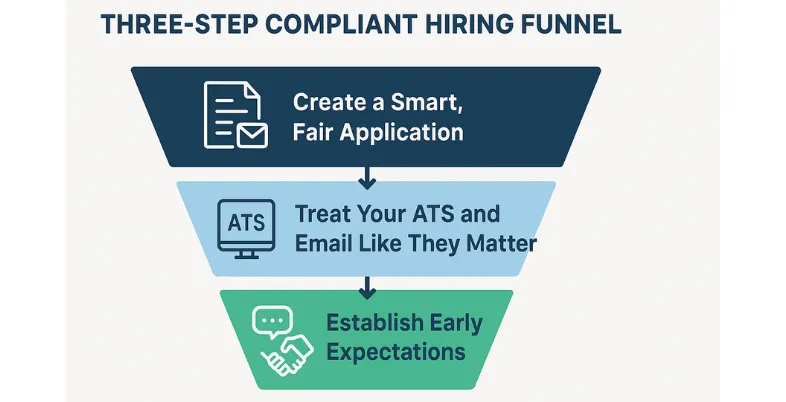
Step One: Create a Smart, Fair Application
The goal is to make the paper trail as painless as possible. Which means the first thing your funnel needs is a solid job application form. After all, you want your applicants to make it through page two.
Tips to Consider:
- Keep Your Questions Relevant: Instead of asking, “what year did you graduate”, ask what applicable skills they bring to the team. All of your questions should be connected to the job.
- Respect Privacy: Straight out of the gate, let your applicants know how their information will be used. You can get into trouble by trying to be shady, sneaking privacy details in the fine print.
- Confirm Consent: Make it very clear. “By submitting this, you’re okay with us contacting you.” Put it right up front, focusing on simple and clear words, instead of concealing it forteen paragraphs deep.
A Reminder about Inclusion
Accessibility matters. Everyone should be able to apply for your job opening on any device using screen readers or other assistive tech.
Don’t let a wonky “submit” button keep you from landing awesome candidates.
Step Two: Treat Your ATS and Email Like They Matter
In case you haven’t heard, your ATS is the heart of your operation. If you choose a quirky one, then your funnel might end up feeling like it’s stuck in the 90’s.
Start with simple integration. Your applicant tracking system should easily communicat with your background check services, as well as your onboarding tools. No one wants to be up at midnight copy and pasting resumes.
Then set up an automated nurture campaign. Reach out periodically with a friendly email to show your candidates that you’re happy to have them involved.
Make sure to keep it mobile-friendly throughout the entire process. If your candidates can’t read your emails easily they’re going to quickly lose interest.
Break out the Onboarding Heavyweights: Form I-9 and E-Verify
Speaking of onboarding tools, once your offer letter is signed, you’re still not done with compliance just yet.
Many slip up when it comes to the Form I-9 and E-Verify. These steps don’t need to feel like a tax season chore. The secret is to use resources that guide everyone, from HR to the applicant, with no confusion.
As you’re mapping content for your onboarding flow, Essium’s I-9 and E-Verify tools break down everything with straightforward guides. This way you give candidates a heads-up about what documents to gather so no one has to experience any last-minute panic.
Step Three: Establish Early Expectations
No one likes surprises, especially when it comes to paperwork. As soon as a candidate accepts your job offer, set your expectations right then and there.
What are you going to need from them?
- Driver’s license?
- Passport?
- Favorite mug for the first day selfies?
It’s helpful to send a list of acceptable documents, along with a timeline, and a quick rundown of what each step will look like. Use plain English and throw in a few real-life tips so the candidate doesn’t feel like they’re cramming for a pop quiz.
Accessibility and Privacy for the Win
Keep in mind that not all candidates will engage the same way.
Some are fast on their phone, others need screen readers, and a few might need a little extra time to fill out tricky forms.
Test your entire process for accessibility, from your job application to onboarding documents. Also ensure that every touchpoint pops up with crystal clear info about how personal data is used and stored.
If you want to keep lawyers and candidates happy, do not skip this detail.
Measure What Works (And What’s a Headache)
Once your funnel is up and rolling, don’t just give yourself a high-five and walk away. Now’s the time to start tracking drop-off rates. See where in the process people bounce.
If every fifth candidate stops on page three of your application, that’s a red flag.
Ask for feedback when you’re sending out those automated emails and use that valuable information to keep tweaking your funnel. Eventually, it will work for real people, not just the ones who love to complete paperwork.
Never Mind the Technical Talk: The Layperson’s Guide
Let’s skip over the jargon and break down what your compliant funnel actually needs:
- Lock-Tight Data Security: Make sure confidential information is securely protected at every stage, from application to onboarding.
- Prioritize Simple System Integrations: Your ATS, onboarding, and background screening should all “talk” to each other seamlessly. That practically eliminates mistakes and double-entry.
- Maintain Impeccable Audit Trails: Keep records tidy so you can show who did what, when, if anyone ever asks.
Key Takeaway: Lock up personal information like it’s your secret snack stash. If your tools aren’t in sync with each other, it’s just like having to repeat your name ten different times at the DMV. And always keep a paper trail strong enough to prove nobody messed around with candidate files.
A Compliant Funnel Pays Off
Hear me out, having a totally compliant hiring funnel can make your workday measurably better.
To begin with, you’ll be saving real time and protecting your sanity because those automated details and connected tools will be doing the heavy lifting.
That translates to less time scrambling for signatures and completed forms, and more time to nurture real connections with your new hires instead of chasing down paperwork.
Then there’s the added bonus of candidates knowing what to expect when they see you handling their information with care and consideration. This sets the foundation for trust in your company right off the bat.
That’s the sort of trust that turns into good buzz; it’s the kind of word of mouth that every employer wants.
But, maybe, the best part of all is that you’re avoiding late-night panic moments brought on by a blurry audit trail. Because once you’ve established a lock-tight audit trail, and every stage of onboarding is clearly spelled out, you’ll always know that you’ve collected all the right documents within the required time.
Instead of sweating over missing paperwork, you can actually relax and focus on helping your team celebrate landing that great new hire.
To put it in the simplest of terms, keep your funnel simple, clear, and friendly. You’ll not only establish trust early, but also your candidates, your legal team, and your stress levels will all thank you.
FAQs
1. What is a compliant hiring funnel, and why does it matter?
A compliant hiring funnel is a structured recruitment process that follows legal requirements, treats candidates fairly, and ensures a smooth experience. It helps protect your company legally, builds trust with candidates, and streamlines hiring.
2. How can I make my job application legally compliant and fair?
Keep questions relevant to the job, respect candidate privacy, clearly obtain consent, and ensure the application is accessible on all devices, including screen readers and assistive technology.
3. What role does an ATS play in compliance?
An Applicant Tracking System (ATS) organizes candidate data, integrates with onboarding and background check tools, supports automated communication, and maintains audit trails to ensure compliance at every stage.
4. How should I communicate expectations to new hires?
After a candidate accepts an offer, provide a clear list of required documents, timelines, and step-by-step instructions in plain language to prevent confusion and ensure smooth onboarding.
5. How do I track and improve my hiring funnel?
Monitor candidate drop-offs, collect feedback from automated emails, and use the data to refine the process, making it more user-friendly, efficient, and legally compliant.
