
The principal of the Indian democracy is universal adult franchise. It is the ability of all individuals who are above the voting age to participate in voting regardless of their person. In India, over 968 million individuals are able to vote, which is the highest in the world (up to 2026). This rule indicates the way in which India attempts to involve all people in the political process despite the fact that India is a very diverse country.
In 1950 India granted a right of voting to approximately 173 million of the population, which also included women and marginalized people who had never elected before. In general elections, voters are presently participating in the elections at 67.4%. The system is continuously being enhanced and assists the electorate of all classes in voting.
India has taken a step towards universal adult franchise, which is the Government franchise anddemonstrates in its efforts to ensure fairness. Now young people are allowed to participate in politics since 1989, the age at which one could vote is 18. Due to this rule, 17 free elections have been held in the country since it got its independence. The system is a good one as it maintains the peace and assists the society transformation.
What is Universal Adult Franchise
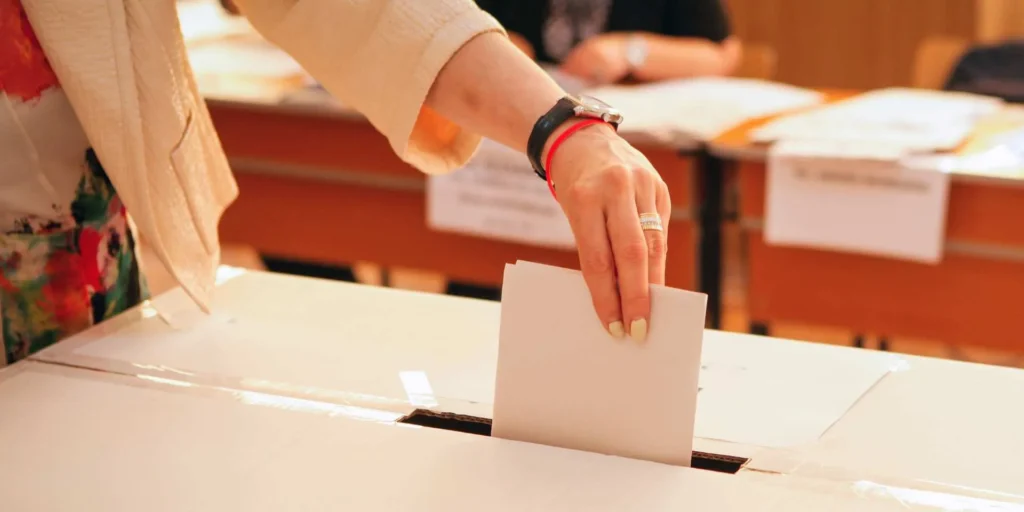
Universal adult franchise implies that all adult people can vote regardless of their caste, creed, religion, sex, education, or income. In India there is no discrimination and anyone is eligible to vote as long as he is 18 years.
Election Commission of India operates approximately 1.05 million polling stations to enable so many people to vote. The rule abolishes the previous rules that required you to possess land, money, or a degree to be able to vote. The number of voters is more than 968 million by the year 2026. An uneducated village farmer has the same voting power as a businessperson in a city.
Universal adult franchise incorporates the principle of one person, one vote. There are currently 48.3 percent of women voters in 2026. This indicates that the system supports the participation of everyone, including women.
Franchise vs. Suffrage: Brief Etymology and Distinction
The meanings of franchise and suffrage are used interchangeably by people yet the words are of old French and Latin origin. In India, the two are the right to vote. The term “universal adult franchise” is used in official documents.
Article 326 of the Indian Constitution refers to the voting rights by the use of the term franchise. Approximately 195 countries in which adults vote in the year 2026 and the age starts as low as 16 to 21. The name of India reflects its legal history as in the Constituent Assembly.
Differentiating is important when considering old documents and comparing laws. Universal adult franchise does not just imply voting; it demonstrates that all votes are equal. In 2026, 77.7% of the literate world will read, yet the right to vote is independent of how much one can read. In some Western countries, it differs from old restrictions.
Historical Evolution
Before Independence
In British India, there were high limitations on voting before independence. It was founded on the possession of land, payment of taxes and a certain level of education. Only about 5.5 million of 250 million adults (1919 Act) were allowed to vote. The majority of Indians women, poor, and marginalized individuals were not able to vote.
Under the 1935 Act, more people were allowed to vote (approximately 35 million, or 14 percent of adults); nevertheless, the rules were discriminatory. You were required to own land, have a degree or pay some taxes. The British never gave up overall power; thus, the appearance was one of representation, though not actual.
Theoretically, women were allowed to vote in the 1935 Act; however, due to property and literacy restrictions, the number of women voters was less than 3 percent. This small and limited voting rule was observed in the 1937 and 1946 elections. These issues compelled the Indian National Congress to advocate for granting full voting rights to all adults when India gained independence, despite the notion that Western democracies achieved voter expansion gradually.
Freedom Movement and Debates
The leaders and freedom fighters of India always argued that real democracy must have a universal adult franchise. Mahatma Gandhi observed that political freedom cannot be complete without social and economic equality. The Congress party, during meetings in the 1930s and 1940s, demanded the right of all adults to vote.
Between 1946 and 1949, the Constituent Assembly debated extensively whether and when the entire adult population should be granted the right to vote. They feared it would be difficult with low literacy (less than 18 percent), and wanted a gradual implementation process. Dr. B.R. Ambedkar, the chair of the Drafting Committee, argued that the country must implement but not wait, as doing so would perpetuate social injustice and damage the process of democracy.
Very much supported by 299 members of the Constituent Assembly, this move to grant all adults the right to vote was regarded as crucial to Indian democracy. Even the leaders who espoused the change despite the difficulty were Jawaharlal Nehru, Sardar Vallabhbhai Patel, and Rajendra Prasad. Providing an opportunity to vote to approximately 173 million citizens immediately after independence was an enormous and unprecedented step that neither Britain nor the US had taken before.
Post-Independence Adoption
On January 26, 1950, the right to vote was granted to every adult in India, following the adoption of the Constitution. It granted the franchise to all citizens who had reached the age of 21. In 1951-52, the first general elections were carried out. Approximately 173 million individuals were eligible to vote, and 106 million voted. That was a turnout of 61.2 percent. They hired an additional 224,000 polling staff nationwide and printed 16.5 million ballot boxes just to conduct the elections.
Running the votes was hard. Nobody could read, there were not many roads or trains, and the government had not had much experience with elections this big. The original chief election commissioner, Sukumar Sen came up with special signs meant to represent the political parties so that the illiterate population could use them to identify the party that they follow. India has over 200 party symbols that are still applicable as of 2026.
These initial elections indicated that the granting of the right to vote to all adults was not a matter of choice but an irreversible constituent of the Indian democracy. Subsequent elections continued to receive increased turnout. In 2024, over 642,420,000 citizens cast their votes out of 968,000,000 eligible citizens. Voting had continued to work even in cases of emergency, political volatility, and massive social transition. The 61 st Constitutional Amendment in the year 1989 reduced the voting age to 18 years instead of 21 years, putting approximately 20 million new voters on the rolls.
Constitutional and Legal Framework
Key Constitutional Articles
| Article | Provision / Subject | Key Details | Significance |
|---|---|---|---|
| Article 326 | Elections based on Universal Adult Franchise | Provides voting rights to all Indian citizens aged 18 years and above for elections to the Lok Sabha and State Legislative Assemblies. Applies to 543 Lok Sabha seats and around 4,120 State Assembly seats (as of 2026). | Establishes the legal foundation of universal adult franchise in India and ensures political equality. |
| Article 324 | Powers of Election Commission | Establishes the Election Commission of India as an independent constitutional body responsible for conducting elections to Parliament, State Legislatures, and Union Territories. | Ensures free, fair, and independent elections without government interference. |
| Article 325 | One General Electoral Roll | Prohibits separate electoral rolls based on religion, race, caste, sex, or place of birth. Provides one common voter list for each constituency. | Guarantees equality in voting rights and abolishes communal electorates introduced during British rule. |
61st Constitutional Amendment
The 61st Amendment in the constitutional amendments of 1988 reduced the voting age to 18. When it began on March 28, 1989, it brought on board approximately 20 million young voters in the first instance. This vindication indicated that the legislators were recognizing the ability of the youths and wanted them to be earlier adherents of democracy.
Importance of Universal Adult Franchise
Core Democratic Values
- Universal adult suffrage ensures that every citizen has equal voting power, regardless of caste, religion, gender, education, or income.
- Over 968 million Indians (2026) participate in nation-building through voting.
- It rejects the idea that only the educated or wealthy should decide leadership.
- Government authority derives from the consent of the people expressed through elections.
- Voting promotes social dignity, treating all adults as responsible and equal citizens.
- It creates a level playing field in a socially diverse country like India.
- In 2026, regions with a higher proportion of disadvantaged communities recorded over 72% voter turnout, reflecting strong democratic participation.
- Voting encourages citizens to engage in political discussions and public decision-making, not just leadership selection.
- It has enabled people from diverse social backgrounds to enter Parliament.
- The present Lok Sabha represents members from 450+ castes and communities, showcasing inclusivity.
- Universal adult franchise strengthens the values of equality, freedom, and social harmony in Indian democracy.
Institutional Relevance
- Universal adult voting gives legitimacy to the State, as leaders are elected through ballots, not military power.
- Regular elections ensure accountability of leaders and prevent concentration of excessive power.
- Since 1952, 17 General Elections have been conducted in India with peaceful transfers of power.
- The system strengthens democratic stability, especially compared to many newly independent nations.
- Voting supports federalism, allowing each state to conduct elections based on local preferences within the national framework.
- India has 28 State Governments and 8 Union Territory legislatures elected through adult franchise.
- The layered electoral system maintains a balance between diversity and national unity.
- State election results often differ from national election outcomes, reflecting regional priorities.
- Democratic institutions such as Parliament, State Legislatures, and Local Bodies function continuously, ensuring governance stability.
- The Election Commission of India conducts around 10–12 major elections annually, demonstrating strong administrative capacity.
- By 2026, approximately 3.2 million elected representatives at various levels help operate the world’s largest democracy.
Social Impact
- Universal adult franchise has brought major social transformation by enabling historically marginalized groups to participate in politics.
- Scheduled Castes (SCs) and Scheduled Tribes (STs), comprising nearly 25% of India’s population, have become influential electoral groups.
- Their voting preferences significantly shape public policies and welfare schemes.
- SC/ST voter turnout often ranges between 73–75%, which is higher than the national average.
- Women’s political participation has increased substantially under universal adult franchise.
- In 2026, women constitute 48.3% of total voters in India.
- States like Kerala and Tamil Nadu have recorded over 78% women voter turnout in recent elections.
- Increased women participation has influenced policies related to healthcare, education, safety, and employment.
- Rural populations and economically weaker sections use their votes to demand development, infrastructure, and public services.
- Farmers, workers, and religious minorities now actively influence the political agenda.
- Higher voter turnout is linked to better implementation of government schemes and stronger public accountability.
Implementation Mechanisms
Electoral Roll and Registration
Universal adult franchise relies on an updated voter list, currently with around 968 million registered voters in India. The list is revised annually, adding new voters who have turned 18 and removing those who have passed away or migrated. Online registration through the National Voter Service Portal allows 1.5–2 million registrations, and campaigns under the Systematic Voters Education and Electoral Participation program target first-time, migrant, and marginalized voters.
Linking Aadhaar with voter ID ensures accuracy and prevents duplication. Despite these efforts, 30–40 million eligible voters remain unregistered due to migration, lack of awareness, or missing documents.
Election Commission’s Role
The Election Commission of India safeguards universal adult franchise, ensuring free and fair elections at all levels. It employs ~300 permanent staff and can deploy over 10 million personnel during general elections. Independent under Article 324, the Commission regulates political parties, monitors campaign funding, and enforces election laws. It uses technology such as Electronic Voting Machines (EVMs) and Voter Verifiable Paper Audit Trails (VVPATs) at 1.05 million polling stations.
The Commission oversees about 3,000 political parties, including 8 national and 54 state parties, and enforces rules such as the Model Code of Conduct. Its voter education programs reach over 200 million citizens to ensure smooth elections.
Global Perspectives and Comparisons
India adopted universal adult franchise immediately in 1950, while Western countries expanded voting gradually—the UK in 1928 and the US in 1965. India now has the largest voter base in the world (968 million in 2026), surpassing the US (245 million), the EU (447 million), and Indonesia (205 million) combined. The scale of elections, with voters across urban and rural areas, showcases India’s administrative and logistical strength.
Some countries, like Austria and Brazil, allow voting at 16, while most, including India, set the voting age at 18. Unlike about 26 countries with compulsory voting, India’s voting is voluntary, yet turnout remains significant. Unique Indian features include ballot symbols for illiterate voters, seat reservations for marginalized groups, and state-financed elections, which are often studied by other democracies.
Contemporary Challenges
Although the Indian universal adult franchise has been in practice for seventy years, it still faces significant modern-day issues that need to be addressed immediately. By 2026, it is estimated that roughly 30-40 million eligible citizens are not registered on the electoral rolls, either due to relocation to urban areas, issues with documentation, or a lack of awareness.
- Electoral Violence: Campaign-related and election-day violence persists in certain regions. Approximately 150-200 sensitive constituencies require intensive security during elections, which will prevent people from voting and damage free choice.
- Money power: Illegal election spending is not addressed by a rule. It can be 5-10 times higher than official limits, which is unfair to candidates with higher merits.
- Misinformation and Polarization: False electoral information travels rapidly on digital platforms. India has around 2.5 billion social media users, who are increasingly exposed to unverified assertions, community appeals, and fake information as the election approaches.
- Voter Apathy: Urban areas have lower voter turnout, between 55-58 percent, while rural areas have higher voter turnout, between 68- 70 percent. This indicates a decline in civic participation among educated and affluent groups that ought to vote in greater numbers.
- Registration Gaps: Transgender individuals, the homeless, and nomads do not have an easy time with registration.
Case Laws and Judicial Insight
Indian courts have actively safeguarded the right to vote through landmark judgments. In 1952, N.P. Ponnuswami v. Returning Officer established that election disputes are serious constitutional matters and that courts oversee election conduct.
In 2013, the NOTA verdict allowed voters to reject all candidates during electronic voting, used by over 60 million voters. In Lily Thomas v. Union of India (2013), the Supreme Court barred convicted legislators from holding office, protecting voters from intimidation.
Courts continue to protect voting rights for migrant workers, overseas voters, and in cases of digital election threats. By 2026, around 4,500 election-related cases remain pending, reflecting the evolving legal safeguards of India’s electoral system.
Universal Adult Franchise and Social Empowerment
Universal adult franchise in India empowers marginalized groups to challenge traditional power structures. Representation of Scheduled Castes and Scheduled Tribes in the Lok Sabha has risen to 78 and 47 members, while 78 women now serve, marking progress in gender inclusiveness.
Higher voter turnout among poorer communities leads to better access to education, healthcare, and poverty-related programs. In 2026, regions with over 30% SC/ST voter participation recorded an overall turnout of more than 71%, influencing development priorities.
Women, in particular, benefit, gaining political power independent of family or patriarchal influence and contributing to changes in property rights, workplace safety, and maternity benefits. With 468 million women voters, universal franchise is reshaping society, granting rights, dignity, and equality to all.
Conclusion
The universal adult franchise is the greatest democratic success in India, transforming the lives of millions into active participants in the national destiny. Since 1950, the system has demonstrated that democracy is possible in illiteracy, poverty, and diversity. India is a testament to the fact that just governance is built on political equality; the country registers 968 million registered voters as of 2026. The electorate has increased in both numbers and the range of engagements, reaching almost a billion people, compared to 173 million voters in 1952.
Such challenges as electoral violence, money power, and a gap in registration require continuous assistance, as well as new ideas. But the spirit of universal adult franchise remains firm in politics and society. The concept has ensured peaceful transitions of power, the empowerment of marginalized groups, and the maintenance of organizations during difficult periods. On the way to India, the question of how to make voting compatible with addressing emerging challenges will determine whether the constitutional promise actually provides the genuine political force for everyone, thereby continuing to make democracy a lived reality.
Frequently Asked Questions
What is the minimum voting age under universal adult franchise in India?
India has a minimum age of 18 years to vote. The 61 st Constitutional Amendment Act of 1988 made it, and the population of new young voters increased to approximately 20 million immediately.
Which constitutional article guarantees universal adult franchise in India?
Article 326 will ensure that all citizens 18 years and older would be eligible to vote. It declares that no one can use discrimination in Parliament and state assembly elections based on religion, race, caste, sex, and any other grounds.
How many eligible voters does India have under the universal adult franchise system?
There are approximately 968 million registered voters in India. It is the largest democracy in the world with 1.05 of the 20 million polling stations located all over India taking the votes.
What is the difference between franchise and suffrage in democratic terminology?
Franchisement consists in the right to vote. Suffrage refers to the right to vote as well. The words are generally not much different, though, the Indian constitution uses the term of the universal adult voting system a term that was invented in 1950 as franchise.
How does universal adult franchise promote social empowerment in India?
Universal adult franchise enables every individual to have their voice heard in elections. It assists the marginalized demographics such Scheduled Castes, Scheduled Tribes, women and the poor to be represented. Policies can be oriented towards equality and social justice because their voting power can influence them.
