Starting a trucking company in India—or anywhere in the world—is a high-potential business opportunity in 2026. With over 70% of freight transportation handled by trucks, the demand for logistics services continues to grow rapidly, especially in India, due to expanding infrastructure, eCommerce, and industrial development.
However, learning how to start a trucking company successfully is not just about buying a truck. It requires proper planning, legal compliance, smart investment, and operational strategy.
Whether you are:
- an experienced driver planning to become an owner-operator, or
- an entrepreneur looking to build a fleet-based logistics business,
This guide will walk you through everything step by step.
You’ll learn:
- How to start your own trucking company in India
- required licenses and permits
- cost, profit margins, and business models
- Tips to grow and scale your trucking business
We also highlight some of the best trucking companies to work with or partner with, helping you understand industry standards and opportunities.
By the end of this guide, you’ll learn how to start a trucking company in 2026.
Brief Overview of the Trucking Industry
The trucking industry can be described as the lifeblood of global commerce, with about 70% of all freight in several economies being moved on trucks. This sector contributes about 4.5% to the GDP in India, whereas millions of trucks transport goods on an ever-expanding road network. Understanding how to start a trucking company has its advantages, especially with recent developments in infrastructure and the introduction of GST, which has technically simplified interstate commerce.
Also According to Statista; Globally, the trucking market is poised to surpass $1.5 trillion, and countries like the United States highlight just how crucial this sector is. In 2020, the U.S. trucking industry alone was worth $732.3 billion and employed over 902,000 truck drivers—still falling short of industry needs. The resulting driver shortage has made labor costs one of the biggest challenges in the sector.
There are many entry points for entrepreneurs—single owner-operators to fleet managers—with sustained demand from the manufacturing, retailing, agriculture, and construction sectors. The same technological advances that improve operational efficiency in this sector also require a higher level of adaptation and innovation by industry players to remain competitive in a fast-evolving market.
Highlight the Potential and Challenges
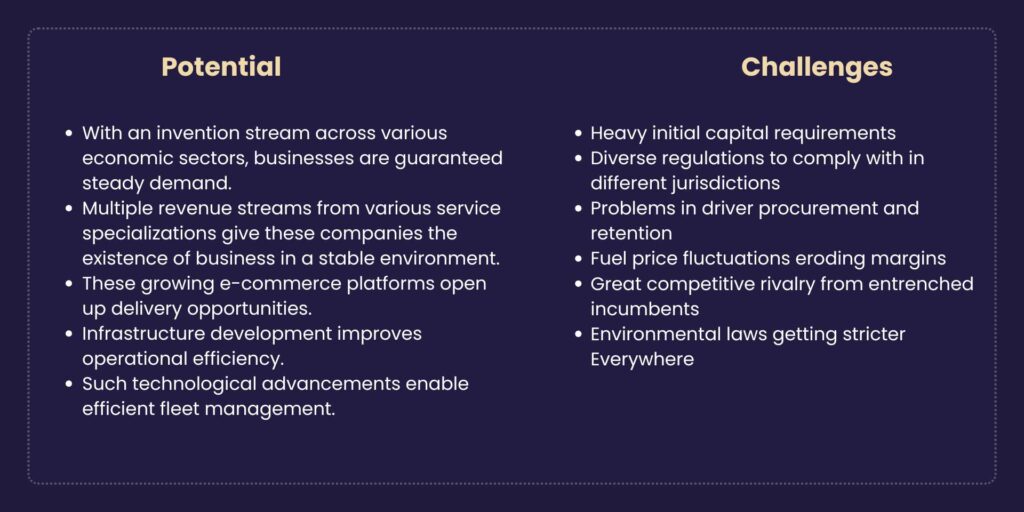
Potential:
- With an invention stream across various economic sectors, businesses are guaranteed steady demand.
- Multiple revenue streams from various service specializations give these companies the existence of business in a stable environment.
- These growing e-commerce platforms open up delivery opportunities.
- Infrastructure development improves operational efficiency.
- Such technological advancements enable efficient fleet management.
Challenges:
- Heavy initial capital requirements
- Diverse regulations to comply with in different jurisdictions
- Problems in driver procurement and retention
- Fuel price fluctuations eroding margins
- Great competitive rivalry from entrenched incumbents
- Environmental laws getting stricter Everywhere
Why Start a Truck-Driving Business in 2026?
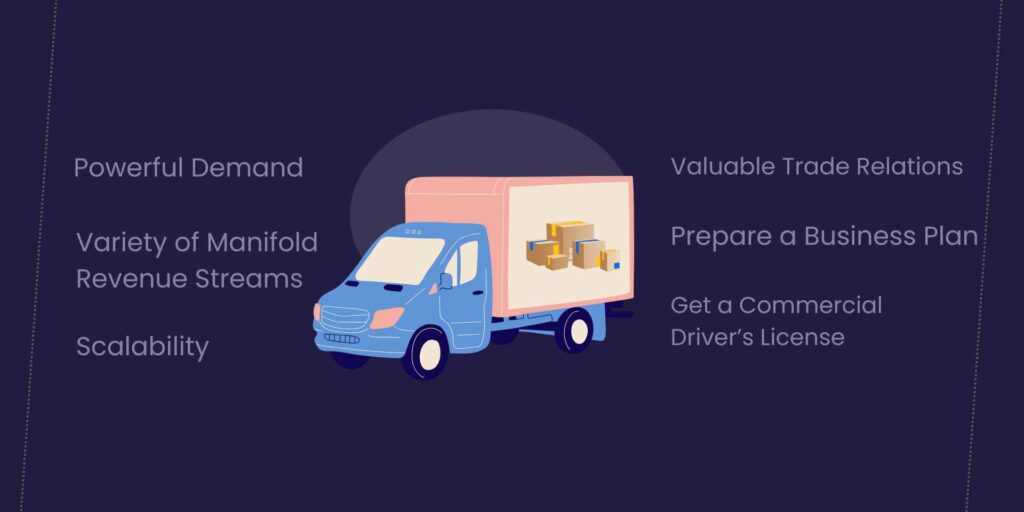
- Powerful Demand: The transportation industry remains highly stable due to constant supply chain needs. In the U.S., 72%+ of freight moves by trucks, with a market size of $900+ billion, ensuring strong long-term demand.
- Variety of Revenue Streams: You can specialize in segments like general freight, refrigerated transport, or hazardous materials. In 2026, reefer, e-commerce, and last-mile delivery offer higher profit potential.
- Scalability: Start with one truck and expand over time. With 580,000+ trucking companies in the U.S., most being small fleets, scaling to 10–20 trucks is a proven model.
- Valuable Trade Relations: Building direct contracts with shippers (manufacturers, retailers) can boost margins by 10–25% compared to broker-based loads.
- Prepare a Business Plan: With freight growth at just ~1–2% in 2026, a solid plan is crucial to manage costs, competition, and profitability.
- Get a Commercial Driver’s License (CDL): A Class A or B CDL is mandatory in the U.S. With a 60,000+ driver shortage, licensed drivers have strong earning opportunities.
- Get a Commercial Driver’s License: If you plan to start a trucking enterprise in the southern United States, obtaining a class b license is essential. For those interested in routes or operations in Texas, local CDL training programs specifically prepare drivers to meet regional requirements and industry standards.
How to Start a Trucking Company in 2026: Step-By-Step
Step 1: Research and Planning
Creating a Business Plan
A sound business plan is the basis for your ideal trucking venture. If you’re figuring out how to start a trucking company, start off with thorough market research outlining demand patterns, competitor strengths, weaknesses, and possible niches. This would be a basic outline for your business plan:
- Executive Summary: A somewhat concise summary of their business idea, goals, and financial projections.
- Company Description: The items would be its business structure and mission statement, as well as unique value proposition.
- Market Analysis: Overall research into the trucking industry, particularly while starting off into Indian markets or with respect to the target region, and to growth projection and opportunity analysis.
- Organization Structure: The legal structure of your company will be outlined along with the management team.
- Service Offerings: Mention the different trucking services that will be availed.
- Marketing Strategy: Strategy for attracting customers and retaining them.
- Financial Projections: Initial costs, running costs, projected revenue, break-even analysis.
- Funding Requirements: Now it’s going to take them into how much capital they are going to want and how they’re going to get it.
Step 2: Defining Your Niche and Business Model
The trucking sector is divided into specialized sectors with distinct requirements for the type of equipment that is required, for the regulations governing the operations, and for the profit that can be earned:
- General Freight: The moving of standard goods that usually need dry vans.
- Refrigerated Transport: Depending on the need for temperature requirements.
- Flatbed Transport: For larger machinery or construction materials, these are moved.
- Tanker Transportation: Transporting liquids or gases.
- Specialized Transport: Transporting hazardous materials or oversized loads
When starting in the above-said transportation services in India, one should think about a regional aspect that will guide him to niche selection. For instance, it is possible that refrigerated transport service would do well in agricultural areas, whereas flatbed and specialized transportation may be required in industrial areas.
Step 3: Developing a Comprehensive Business Plan
Your business model will define how you organize your operations and use these to scale: for example:
- Owner-Operator: manage and drive a single truck yourself.
- Small Fleet Owner: up to a few trucks, hire drivers.
- Fleet Management: the larger operation of multiple trucks and drivers.
Each model requires a different amount of capital, with different management challenges and earning opportunities attached. Your business plan should explain the model you have chosen and offer a guide for growth as your business matures.
Step 4: Navigating the Legal and Regulatory Maze
If you’re exploring how to start a trucking company, establishing one requires careful navigation through various legal and regulatory requirements. Here are the essential steps to register your business, obtain necessary permits, and manage tax obligations:
- Business Formation: Choose a business structure (LLC, Corporation, Sole Proprietorship) then register it with the Secretary of State in your state.
- Get Your EIN: Secure an Employer Identification Number for tax purposes via the IRS.
- DOT Registration: Register with DOT and acquire a USDOT number.
- Motor Carrier Authority: Apply for MC Number (Motor Carrier Authority) with the FMCSA for interstate operation.
- International Registration Plan (IRP): Get apportioned plates if going across state lines.
- International Fuel Tax Agreement (IFTA): Register for fuel tax reporting if operating in different jurisdictions.
- Heavy Vehicle Usage Tax: File Form 2290 for trucks whose gross weight exceeds 55,000 pounds.
- BOC-3 Filing: Designate the process agents in the states where you intend to operate.
- Insurance Requirements: Provide appropriate liability and cargo insurance coverage at minimum levels federally.
- State Specific Permits: Learn what other permits your individual states require (oversize/overweight, hazmat, etc.).
- Unified Carrier Registration: Register every year in the UCR program.
- Ongoing Tax Obligations: Prepare for estimated taxes to be filed quarterly, pay fuel taxes, highway use taxes, and annual business tax filings.
- Legal Support: Have a truck accident attorney on hand in case one of your vehicles is involved in a crash, to help you with liability issues, deal with insurance, and handle any legal fallout so you’re not caught off guard.
Step 5: Acquiring Your Assets: Trucks and Equipment
Acquisition of fleet and equipment for a trucking business starts with a lot of considerations. Important points that would guide this key investment are:
- New vs. Used: Assess your budget and operational needs. New trucks have warranty and reliability, but higher costs associated with them, while quality used trucks can give good savings.
- Buy vs. Lease: It depends on your financial condition. Buying builds equity, but has to be done by a higher initial capital. Leases are lower than upfront costs but no ownership; they are good on maintenance though.
- Financing Options: Commercial vehicle loans, equipment financing, and SBA loans. Cultivate relationships with lenders who understand the trucking industry.
- Spec Requirements: Select trucks that are appropriate depending on your intended freight (dry, refrigerated, flatbed, etc.) and by traveling geography (local versus long-haul).
- Fuel Efficiency: Aerodynamic designs need to be prioritized, as well as fuel-efficient engines that would help control operating costs for the long term.
- Maintenance Factors: When selecting truck makes and models, consider things like service intervals, parts availability, and dealer network support.
- Technology Integration: Invest in ELDs, GPS tracking, and fleet management software to make operations efficient and compliant.
- Primary Equipment: Auxiliary equipment, such as tarps, straps, chains, loading equipment, and communications devices, should also be factored into the budget.
- Resale: Investigate brands and models that have strong resale value, so you can maximize the return on investment.
- Scalable: Develop an acquisition strategy that considers strategic growth without being overextended financially.
Step 6: Building Your Team: Drivers and Support Staff
Part of creating a powerful trucking company is assembling the right team of professionals who would serve as the backbone of your trucking operation. Below are essential matters to know regarding hiring drivers and support staff:
For Drivers:
- Choose candidates with clear driving records, valid CDLs with appropriate endorsements, and verifiable experience
- Conduct thorough screening including background check, drug test, and reference checks
- Decide on owner-operators or company drivers according to your business model
- Develop attractive packages to attract quality drivers in a competitive market
- Make expectations about routes, schedules, and company policies clear
For Support Staff:
- Hire dispatchers who have skills in communication, problem-solving, and logistics coordination
- Invest in knowledgeable administrative personnel who will manage compliance documentation and paperwork
- Think about mechanics that your company will hire in-house or contracted
- Employ logistics coordinators to utilize the best routes possible
- Add some accounting staff to handle invoicing, payroll, and financial management
Start small and then scale your team as the operations require. Remember that your people are your best asset-cultivating a positive company culture with opportunities for growth will minimize turnover and build a loyal-reliable workforce that will push your business forward.
Step 7: Get the Necessary Insurance
Getting the proper insurance for your trucks is a must-have before permitting them to hit the road. Some important points include:
- Take commercial automobile liability insurance, which has a federal minimum of $750,000 for each vehicle
- Get cargo insurance to cover the shipments (which is usually between $100,000-$250,000)
- Add physical damage coverage for your trucks and equipment
- You may consider adding general liability for claims, which do not concern vehicle-related matters
- Look into workers’ compensation insurance for the employees
- Occupational accident insurance for independent contractors should also be considered
- Shop around rates with various carriers specializing in trucking
- Work with an agent experienced in transportation
- Budget into 8-12% of operating costs insurance premiums
- Good safety practices and clean record can give you lower premiums over time.
Step 8: Recruit and Train Drivers
The finding and training of quality drivers constitute a prerequisite of your trucking company’s success:
- Harness industry job boards, participatory social media, and referral programs
- Attendance at trucking job fairs and networking events
- Collaboration with CDL schools to source fresh talent
- Check, check, and double-check all qualifications, licenses, and experiences
- Conduct extensive background checks and drug-field tests
- Instill structured onboarding programs for company policies
- Hands-on training in the operation of specific equipment and type of cargo
- Implement ride-along(s) with experienced drivers
- Continuous safety training and certification
- Reinforcing performance metrics and feedback systems
- Competitive pay, benefits, and quality of life
- Create advancement opportunities to assist with retention
Step 9: Get Operations and Management Done
Best operational and management considerations are:
- Set reliable fleet management software for the vehicle tracking, maintenance management, and route optimization
- Institute well-defined dispatch protocols concerning load assignment and communication with the driver
- Plan scheduled vehicle maintenance systems to preclude the breakdowns and extend vehicle lifespan
- Design comprehensive record-holding systems, to comply within the Department of Transportation guidelines
- Create strong ties with consumers, brokers, and shippers to maintain steady business
- Implement fuel management, from discount programs, relays along the routes
- Setting clear collection procedures for invoices and payment flows to generate cash ongoing
- Emergency protocols for accidents, breakdowns, actually, delay
- Construct quality control principles for standardizing the delivery of services
- Create key performance indicators to monitor, such as deadhead miles, on-time delivery, and fuel consumption
- Have regular team meetings to rectify issues
- Create a standard operating procedure for each aspect of the business
- Develop clear channels for customer feedback and complaints resolution
- Balance the growth rate to the carrying capacity of operations so that one does not overreach
- Adaptive to changes in market conditions and industry regulations.
Step 10: Marketing and Growing Your Trucking Company
To reach sustainable growth within this competitive trucking industry, a strong market presence should be in place:
- Create a professional website that describes services, equipment, and safety records.
- Create a brand image that has unique logos and communicates consistently.
- Use social media to update the company and share expert opinion.
- Join industry associations and participate in networking events to develop business relationships.
- Consider focused marketing to some shipping niches (e.g., refrigerated, oversized, service-oriented, etc.).
- The basics of building an email marketing program should be done to warm those leads and further develop client relationships.
- Set up a referral program to encourage clients in recommending your services.
- Request testimonials from satisfied customers and showcase relevant case studies.
- Develop a relationship with freight brokers. They will connect you to shippers.
- Responding to online reviews will help keep your image clean.
- Ask about advertising on industry forums.
- Provide informative materials on the challenges of shipping to create awareness of the problem in the profession.
- Develop marketing partnerships with synergistic businesses.
- Make sure you keep tabs on the various market trends so that selective growing sectors, in need of transportation, could be identified.
- Build a value proposition that will speak of the differences in service that your operation offers, as opposed to competitors.
- Aim for quality service that would keep clients returning and referring you through the mouth.
Your marketing needs to be steady and sustained by service excellence; only then will sustainable growth follow for your trucking operation.
You Might Like: Best Trucking Companies to Work
Step 11: Financial Management and Profitability
Finance management is imperative for a trucking company considering its long-term prospects:
- Install a strong accounting software tailored for transportation business
- Draw out comprehensive financial projections right from start-up costs to monthly operating costs
- Provide clear rate structures that ensure profitability at competitive rates
- Carefully monitor cash flow to work out the gap between actual service delivery and payment.
- Develop strategies for addressing high-cost areas such as fuel, insurance, and maintenance
- Activate fuel surcharge policy to avoid weakening margins considering price fluctuations
- Regular Review On Cost-Per-Mile Figures To Identify Opportunities For Efficiency
- Keep business accounts separate; make sure that personal finances would not be co-mingled.
- From the onset build relationships with financial institutions for potential future capital needs.
- They build emergency funds to cope with unforeseen repairs and other disruptions in the business.
- Consider factoring services to improve cash flow when clients take long to pay.
- Constantly assess supplier contracts to assess and renegotiate for cost optimization.
- Implement an effective tax planning strategy for the trucking industry.
- Design systems to track and manage driver reimbursements and per diems.
- Fleet expansion only when the financial signs point in favor of growth.
- Schedule regular financial reviews to adjust strategies based on performance data.
Conclusion
How to start a trucking company requires hard work and preparation. Putting your legalities into order—registering your business and obtaining the permits and insurance that are needed for your truck in the first instance.
Make sure to invest in good equipment for the model of your business. Develop a quality team of drivers and support staff, with an emphasis on responsible hiring and training. Invest in insurance to cover your assets. Set up systems for operations and financial management. Your service should be marketed to the client segmentation you will attract. While it has its own obstacles, the industry has a lavish reward for any entrepreneur willing to work for excellence, compliance, and constant improvement.
Ready to hit the road? Start drafting your business plan today—or connect with industry experts who can help you move your idea forward.
FAQs
What is the amount of capital required for starting a trucking company?
Start capital required range from $10,000-15,000 for an owner operator leased truck to $200,000 plus for starting with multiple owned vehicles. When going into the Indian market, costs will vary according to prices of the vehicle and other regulations.
Can I start a trucking company with no driving experience?
Yes, even if the industry knowledge is quite important. Partner with experienced drivers or managers and focus on developing and running the business.
What's the most profitable trucking niche?
The most often paid for specialty hauls, be it hazardous material, refrigerated items, or oversized loads, justifiable to include their own respective equipment and certification required.
How long will it be until my trucking company becomes profitable?
Stability is typically achieved by most trucking companies between 12 and 24 months. However, that does not mean that profitability does not vary from one company to another in terms of startup costs, market conditions, and operational efficiencies.