
If you’ve just started your blog or you’ve been at it for a while but your traffic is still frustratingly low — this guide is for you.
One of the most powerful and completely free things you can do to grow your blog’s SEO is to submit your content to high-authority blog submission sites. Not randomly. Not desperately. Strategically.
Here’s what most beginners don’t realise: Google doesn’t just look at your website in isolation. It looks at your entire presence online — who links to you, which platforms feature your content, how authoritative those platforms are, and whether real people are actually engaging with what you write.Understanding the difference between guest posting vs blog submission can help you build a more effective and diversified content strategy.
That’s exactly what blog submission helps with. And the best part? You don’t need to spend a single rupee to get started.
In this guide, I’m going to walk you through absolutely everything — from what blog submission actually is, to why it matters for SEO in 2026, to a massive list of 100+ high DA Blog Submission Sites where you can submit your content for free. I’ll also give you real tips on how to write articles that actually get accepted and noticed, how to choose the right sites, how to submit properly, and what to watch out for.
What Are Blog Submission Sites?
Blog submission is the process of publishing your content on third-party websites, article directories, or blogging platforms.
These platforms already have large audiences and strong domain authority. When you publish on them and link back to your website, Google sees those links as votes of trust. The more quality votes you collect, the more Google trusts your site — and the higher it pushes you in search results.
Types of Blog Submission Sites
Article Directories — These are websites specifically built to host articles from many different writers. Sites like EzineArticles and ArticleBase fall into this category. You submit your article, it gets reviewed, and if approved, it gets published with a link back to your site.
Web 2.0 Platforms — These are free blogging and content platforms where you can create your own profile and publish content. Think Medium, Tumblr, Blogger, Substack, and LinkedIn Articles. These platforms already have massive audiences and high domain authority, which is exactly what you want.
Blog Directories — These don’t host your full article. Instead, you submit your blog’s RSS feed or individual post URLs and they list your blog in their directory. BlogLovin, Technorati, and Blogarama are good examples.
Community Platforms and Q&A Sites — Places like Quora, Reddit, and Flipboard where you can share content, answer questions with links to your blog, or contribute to discussions while naturally referencing your work.
Guest Posting Platforms — Sites that explicitly invite guest contributors. You pitch an article idea, they approve it, you write it, and they publish it with your byline and a backlink. These tend to carry the most SEO weight.
Why Blog Submission Matters in SEO in 2026
- Build Backlinks: Every quality link from a high-DA site tells Google your content is worth trusting. Blog submission is one of the most accessible ways to build those links, especially when you’re starting and can’t yet attract links naturally.
- It drives real traffic: Medium has tens of millions of monthly readers. LinkedIn Articles reaches over a billion users. When your content appears on these platforms, real people read it and click through to your site. That referral traffic is valuable both directly and as an engagement signal to Google. Using reliable SEO software listed in Spotsaas can support this process by helping you monitor backlinks, improve on-page SEO, and optimize keyword strategies.
- Helps Google find your pages faster: Google crawls high-authority sites like Medium and LinkedIn multiple times per day. When your link appears on those sites, your own pages get indexed significantly faster — sometimes within hours instead of days.
- Builds your authority: When your name appears consistently on respected platforms, people start recognising you as a credible voice in your niche. That trust is hard to fake and takes time to build — but blog submission accelerates it.
- It’s 100% free. Paid ads stop working when your budget runs out. Quality backlinks from blog submission keep delivering traffic and authority for months, even years.
Key Benefits of Using Blog Submission Sites
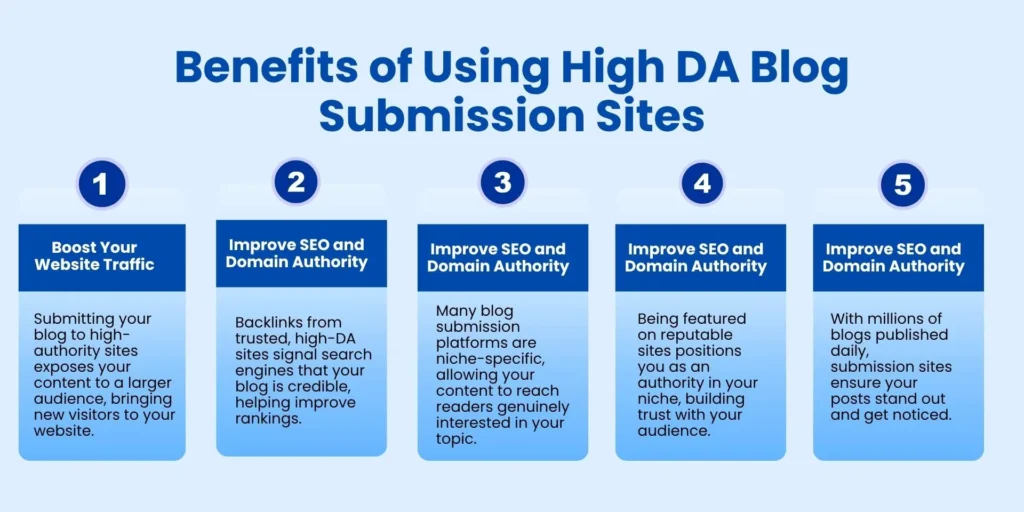
- High-quality backlinks that gradually push your domain authority higher
- Referral traffic from real readers on platforms with large audiences
- Faster indexing — your pages get discovered and crawled much quicker
- Brand visibility across multiple platforms where your target readers hang out
- Networking opportunities with other bloggers, writers, and industry professionals
- Long-term evergreen traffic — articles you submit today can keep sending visitors for years
- Better Google trust signals, especially critical when your site is new and still building credibility
How Is It Different from Guest Posting?
Guest posting is one type of blog submission. When you guest post, you’re writing an original article specifically for another website’s audience, and they publish it as a featured piece. Blog submission is broader — it includes guest posting, but also article directories, web 2.0 platforms, syndication, and more.
Top Do Follow Blog submission sites 2026
Top Blog Submission Sites with DA 90+
Free Blog Submission Sites (High DA) — 2026 List
Instant Approval Blog submission sites List
Tips to Write Awesome Articles for Blog Submission
You cannot simply send a dull or sloppy article. The best sites will reject it. Your article needs to be good! The following are some of the tips to make your writing awesome.
Write for Humans, Not Algorithms
Your job is to write something a real person will enjoy, save, and share. If it’s helpful, Google will reward you for it — eventually. Write like you’re explaining something to a smart friend, not performing for a search engine.
Do Keyword Research First
Before writing a single word, find out what people are actually searching for. Use free tools like Google Keyword Planner or Ubersuggest. Pick one primary keyword with decent search volume and low competition. Then write your article around it — naturally, not robotically.
Write a Great Title
Your title is doing two jobs: telling Google what the article is about, and convincing a human to click on it over everything else on the page. Be specific, use numbers where it makes sense, and make the benefit crystal clear.
Keep It Simple
Write in a clear, simple way. Use short sentences. Use easy words. Do not attempt to sound like a text book. Imagine that you are describing your idea to your friend during lunch.
Break Up Your Text
No one prefers to read a massive wall of words. It hurts the eyes. Enhance the ease of reading your article using tools:
- Headings: Have large and bold headings between your main ideas (as in this article).
- Brief Paragraphs: Be sure to limit your paragraphs to no more than 2-4 sentences.
- Lists: It can make the steps or ideas understandable by using a list with bullet points or a numbered one (such as this one!).
Use H2 and H3 headings, short paragraphs (2–4 sentences), bullet points for lists, and bold text for key ideas. Most people don’t read articles word-for-word — they scan. Make it scannable and they’ll spend more time on the page, which is itself a ranking signal.
Add a Picture
A picture is a lot more entertaining to read. A visual may be used to illustrate your point or simply to make the page pretty. Ensure that you get permission to use the picture.
Read It Out Loud
Once you have completed writing, read your article through. This is a great trick. What you were not able to notice with your eyes, your ears will pick up. You will get to know whether a sentence is excessively long or it sounds out of place.
Proofread Like It Matters — Because It Does
A single typo won’t ruin you. But sloppy, error-filled content signals carelessness. Use Grammarly or read your article out loud before submitting. Platforms with editorial standards will reject poorly written content, and readers will lose trust in you.
How to Choose the Right Blog Submission Sites
Domain Authority (DA):
DA is a score from 0–100 that predicts how well a site ranks in search engines. Use the free MozBar Chrome extension to check. Aim for sites with DA 40+. Anything above DA 70 is excellent. The higher the DA, the more powerful the backlink.
Relevance to Your Niche:
A link from a DA 60 site in your exact niche can outperform a link from a DA 80 general directory. Topical relevance matters to Google. Wherever possible, submit to platforms that serve a similar audience to yours.
Check Real Traffic:
A site can have decent DA but barely any readers. Use SimilarWeb (free) to check actual traffic estimates. A platform with no real visitors won’t help your blog grow — even with a decent DA score.
Submission Process:
Choose platforms that make it easy to submit your blog. Free blog submission sites in India come with simple interface designs.
Every platform has rules about word count, link limits, promotional content, and whether they require exclusive articles. Read these before you write — not after.
Cost Factor:
Choose between using paid blog promotion services or keeping your blog submissions free based on budget requirements.
Avoid Spammy Sites:
If a site looks cluttered, hasn’t been updated in years, or is stuffed with low-quality auto-generated content, stay away. Links from spammy sites, like social bookmarking sites or irrelevant directory submission sites, can actually hurt your SEO by associating your domain with bad neighborhoods.
Spam Score:
Sites with high spam scores can hurt your blog’s credibility so you should choose other options.
Features and Tools:
Review tools that provide performance data and tools for link analysis and search engine optimization to improve your blog.
Pre-Submission Checklist
You have completed your fantastic article. Wait! Do not press the submit button yet. These are some of the quick checks.
- Detect Errors: Have you spelt the words correctly? Were you grammatically correct? A spell-checker program can be used. Minuscule errors may render you unprofessional.
- Check Your Links: You have included any links in your article (such as a link to your own site), then click. Ensure that they are functional and visit the appropriate page. Loss of connection is annoying to readers.
- The Rules (The Guidelines): This is the most significant step! Each site has its own regulations. One of them may state, “Articles should be 800 words. Somebody would tell you that you can only have one link. Otherwise, somebody may say to you, Do not write about money or health.
- Is it 100% Original? You should never duplicate an article on another site and make it look like yours. This is what is referred to as plagiarism or duplicate content. Google hates this. The submission sites detest this. They will ban you. Your article should be new, and you should have written it in its entirety
They will not accept your article if you violate their rules, and you have wasted your time. Read them carefully and then act according to them.
How to Submit Your Blog (Step-by-Step)
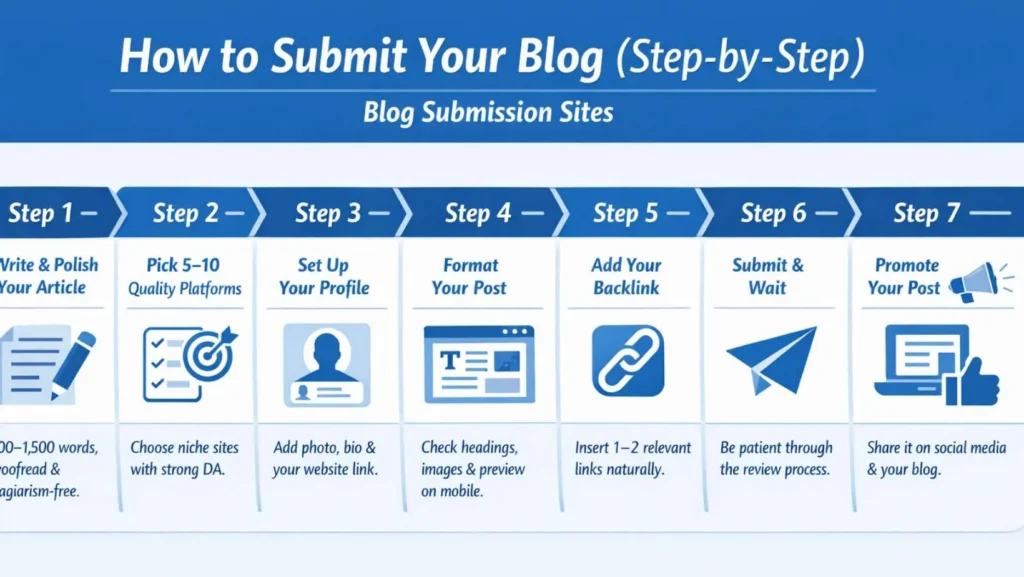
Step 1 — Write and polish your article
Make sure it’s at least 800–1,500 words, well-structured, proofread, and genuinely helpful. Run a plagiarism check before submitting anywhere.
Step 2 — Create a shortlist of 5–10 quality platforms
Don’t try to submit to 100 sites at once. Start focused. Pick platforms that match your niche and have strong DA.
Step 3 — Set up your profile completely
Add a real photo, a well-written bio (2–3 sentences), and your website link. Write a slightly different bio for each platform — this avoids duplicate content and looks more authentic.
Step 4 — Format it properly in the platform's editor.
Check headings, images, and links after pasting. Preview on mobile before publishing. Don’t just dump raw text and hit submit.
Step 5 — Add your backlink naturally
Include one or two links back to relevant pages on your website — not just your homepage. Use natural anchor text. Don’t over-stuff links or it’ll look promotional and get rejected.
Step 6 — Submit and be patient
Some platforms auto-publish immediately. Others have a review process that takes days or weeks. Don’t resubmit the same article repeatedly while waiting.
Step 7— Promote what gets published
Share the article on social media, link to it from your own blog, and engage with any comments it receives. The more engagement it gets, the better it performs on the platform — and the more traffic it sends back to you.
Tested Pro Tips for Blog Submission
Choose High-Authority Sites:
Submit your blog to platforms with strong domain authority scores. These platforms help you get more effective backlinks that increase your website’s search results. Test the domain authority of websites using Moz or Ahrefs before continuing your process.
Avoid Spammy Sites:
Avoid working with blog submission sites that deliver spam content. Submitting to poor-quality sites will hurt your online presence more than help it.
Use Unique and Engaging Content:
Only send new content to these platforms. Update your blog with original and optimized content to earn readers and please search engines.
Leverage Social Bookmarking Platforms:
Several blog submission sites include built-in social bookmarking functions. Post your submissions on Reddit, Digg, and StumbleUpon social bookmarking services to expand your website traffic.
Optimize Anchor Texts:
When you submit your blog URL include keyword phrases directly in the text. Your content becomes easier for search engines to understand which improves your position in search results for those keywords.
Maintain Consistency:
Posting frequently to multiple online platforms keeps your website busy and makes your blog easier to find. Develop a submission schedule for consistency.
Monitor and Update Submissions:
Regularly measure the results from your posted blogs to make better decisions. Regularly adjust your content description and keywords to match and keep the latest SEO strategies useful.
Engage with the Community:
Through your responses to platform comments you strengthen relationships and expand your blog’s audience base through social connections.
Use Multiple Submission Formats:
Several platforms let you post written content alongside visual elements such as infographics and videos. To make the most impact, consider using different presentation methods to match your content with what readers want to see. You might also want to explore interactive videos, which allow viewers to click links, answer quizzes, or choose their own narrative path directly within the player. This hands-on approach dramatically boosts retention by turning passive viewers into active participants. If you’re including videos, it’s a smart move to hire a video editor who can help craft professional, engaging visuals that elevate your message and keep your audience hooked.
Pros & Cons of Using Blog Submission Sites
The Pros
Free, compounding backlinks — You get real, measurable backlinks from DA 50–90+ sites without spending anything. For new blogs and small websites that can’t afford link-building agencies, this is genuinely powerful.
Multiple traffic streams — Every platform you publish on becomes a new traffic source. Medium readers. Quora searchers. LinkedIn professionals. Each is a different audience who might never have found you through Google.
Faster indexing — High-authority platforms get crawled by Google daily. Your link on their page = your site gets indexed faster. Especially helpful for time-sensitive or seasonal content.
Long-term, evergreen results — Unlike social media posts that die in 48 hours, a well-written submission can send traffic for years. The work you do today keeps paying returns well into the future.
Brand authority — Showing up consistently on respected platforms makes you look credible, established, and trustworthy — to both readers and to Google.
The Cons
It takes real time and effort — Writing quality articles, adapting them per platform, setting up profiles, and waiting for editorial reviews is genuinely time-intensive. There’s no shortcut here.
Duplicate content risk — Submitting identical articles to multiple sites confuses Google about which version is the original. Always adapt your content and use canonical tags where available.
Not all sites are worth it — Hundreds of low-quality “submission sites” are basically link farms. Submitting to them can actively hurt your SEO.
No-follow links from major platforms — Some high-traffic platforms like Quora and Reddit use no-follow links. They won’t directly boost your rankings, but the referral traffic and brand exposure are still worth it.
Results take months, not days — If you’re expecting ranking improvements in two weeks, you’ll be disappointed. SEO is a long game. Give blog submission at least 3–6 months before judging whether it’s working.
Conclusion
Blog submission sites give content creators the power to show their content to more people and make their web pages stand out in search results. To produce quality backlinks, you can boost your domain authority through premium platforms and free blog submission websites. Your content reaches further when you pick the right platforms, whether you want worldwide impact or focus on Indian blog submission websites. Your SEO results will likely improve when you submit fresh and compelling content to top-ranked websites. You need both general and targeted websites to reach more potential readers.
Keep an eye on your submissions to make better decisions by using performance data. Your blog will succeed and grow better in digital marketing by carrying out a strategic plan repeatedly. Start reaching more people and improving search engine rankings by using our free worldwide blog submission site directory today.
FAQs
Bloggers use submission platforms to submit their work and earn backlinks plus better online presence.
You can use these services to help new bloggers improve SEO results and attract visitors without spending money.
People commonly use Medium BlogAdda and Indiblogger for their blog submissions.
Find a list of free blog submission sites in India to select the right platforms.
Absolutely! Your blog will gain better search rankings when you submit it to platforms with high domain authority scores.