You entered your song idea into Suno, hit generate, and were blown away by how close to perfect it was. Then, when you tried to use it for your YouTube video, you realized you were out of daily credits.
Don’t worry, you’re not alone.
Suno is, without a doubt, one of the most popular AI music tools currently available. 99 million users can’t be wrong. However, it’s not for everyone, and it’s certainly not the only tool available anymore.
The AI music landscape has changed. In 2026, it’s valued at 1.98 billion dollars. By 2035, it’s projected to reach 18.04 billion dollars, growing at a rate of 28.5% per annum. That’s a lot of cash, and as such, there are now some amazing tools available to compete, including options similar to Deel alternatives that help manage payments and collaborations efficiently.
Are you an individual looking for something free? Are you an organisation seeking an open-source solution? Are you an entrepreneur seeking something for your business? Whatever your needs, there is now an alternative to Suno for your very specific situation. In this article, we’ll explore 15 of the very best Suno AI Alternatives in 2026.
What Is Suno AI?
Suno AI is a text-to-music generator. This tool can transform text into music. The text can be anything like “an upbeat pop song about a road trip.” The tool will then produce music within seconds. The generated music includes vocals, instruments, and lyrics. The tool has been popular among content creators, music hobbyists, and even professional musicians seeking new musical ideas.
However, the following challenges face users of the Suno AI tool:
- The free plan offers 50 credits/day, which equates to 10 songs/day.
- The tool does not allow the use of the generated music for commercial use unless the user has a Suno paid subscription. The minimum subscription cost is $10/month.
- The tool does not have an official API as of early 2026.
- There was some confusion after the Warner acquisition.
- The quality of the music generated by the tool varies. The music generated by the tool is useful 60-70% of the time. The tool uses Suno v4.
Why Should You Consider A Suno AI Alternative?
Although Suno AI emerges as one of the best AI music generators with various useful functions, it is not the best choice you can have. As many people do not find the services of this music AI over many perspectives, such as cost-efficiency, user-friendly interface, lack of features, and many more. Nonetheless, here are a few details why you should consider an alternative to Suno AI:
- Lack of In-depth Production: Although the Suno AI claims to generate music that has emotional depth, in reality, it cannot produce such work.
- Unreliable Music Production: You cannot produce the perfect music you want, despite putting in the right prompts.
- Lack of Human Authenticity: Artificial Intelligence lacks the touch of human vocals and generates machine-like music.
- Insufficient Features: The music AI does not offer any features to remove or alter instruments.
- Not cost-friendly: The Suno AI is not cost-friendly for many individuals as it only offers minimal features with the free version.
Nonetheless, the following issues raise enough reasons for anyone to look for an alternative to the Suno AI.
Key Features of a Good Suno AI Alternative?
- Top-tier Music Production: The alternative should generate music that has proficient and top-tier sound quality. And it should also contain a few factors like melodies, rhythms, chord progression, and many more.
- Personalization and Control: The good alternative should have the right tools for maintaining the key mood, formation, lyrics, and tempo.
- Experience and User-friendly Interface: The replacement for Suno AI should have an intuitive interface for users alongside quick music production times, DAW integration, and many more.
- AI Function And Innovation: The Suno AI alternative must have consistent innovation among various inputs, also it should manage abnormal prompts without acting robotic.
- Genre Creativity: The alternative should produce a variety of music categories such as rap, pop, EDM, classical, and many more. Furthermore, it must be able to produce both instrumental and vocal tracks.
Best Suno AI Alternatives (Quick Comparison Table) 2026
Top 15 Suno AI Alternatives 2026 Update
As we have mentioned all the points for you to choose a music alternative for Suno AI, here is the list of the top 15 alternatives of Suno AI you are looking for:
1. Udio — Best Overall Suno Alternative

At the top of our list, we are going to refer you to the Udio AI for music production as well as an alternative to the Suno AI. Nonetheless, this music AI is mainly popular among individuals and productions because of its intuitive interface, which can effortlessly guide its users to its best features for generating music.
Moreover, the music AI is also prominent for its convenient music generation for producers. Furthermore, users can explore various music categories such as blues, pop, and gospel, which also consist of vocal tracks. Alongside these features, you can use the automated integration function, extensive personalization features, and many more.
Udio is the one most recommended when users say “I want something like Suno, but sounds better.” Udio streams music at 48kHz. This makes the separation between the instruments clearer and the vocals sound more natural. If you’ve listened to music on Suno and thought the vocals were a little robotic, Udio really does sound different.
Key Features:
- 48kHz Audio Output
- Significantly cleaner than most competitors
- Advanced generation parameters (not available on Suno)
- Adjust lyrics as desired, matching rhythms precisely
- Modify or replace elements of song structures
- Supports 30+ genres, including ambient and experimental
Pros And Cons of Udio
Pros
- It offers a robust AI library for music.
- The system has an intuitive interface.
- It has a vast text-to-music converter.
Cons
- Users can only use limited integration functions.
Pricing:
Plan | Price | Generations |
Free | $0 | 600/month (10/day) |
Standard | $10/month | 1,200/month |
Best For: If you want high-quality, vocal-centric songs that are ready to go out of the box, then Udio is for you. Perfect for YouTube, Spotify, or anyone whose main priority is sound quality.
⚠️ Heads-Up: As of 2026, you can only share your Udio tracks on their site. You’re locked into their ecosystem.
2. Soundraw — Best for Royalty-Free Content Creation

If we are looking at the best Suno AI alternatives, you can certainly notice the name of Soundraw among the choices. Nonetheless, this music AI is primarily popular for its vocal compatibility, which helps to produce precise music with proper prompts or textual information. Moreover, this option is undoubtedly a good choice for those who want to examine music.
With this music AI, users can select or alter several factors such as instrument, tempo, category, mood, and song duration to make the perfect track. Moreover, you can also filter differences by modifying bass, melody, drums, and many others to help you analyze several AI-produced tracks.
Soundraw is specifically designed with content creators in mind, such as YouTubers, video editors, podcasters, or marketers. It is not a “write in some text and get your song” type of tool like Suno. Rather, it is more along the lines of “select your genre, mood, tempo, and theme,” and it will produce a set of tracks that can be edited at the individual bar level.
The greatest advantage is the fact that the music is trained on music created by the in-house producers at Soundraw. There is no copyright issue at all. The royalties go to the creator in full.
Key Features:
- Customize sections, instruments, and energy levels with drag and drop editor
- Separate stem downloads (drums, bass, melody, FX)
- 30+ genres to choose from, including Hip-Hop, EDM, Lo-Fi, Orchestra
- Blend genres (e.g., Trap + Lo-Fi)
- Get a lifetime license to all downloaded tracks, even if you cancel
Pros And Cons of Soundraw
Pros
- It can enable vocal integration.
- The AI is a good choice for groups who want to produce music as a team.
- It lets users customize an extensive track.
Cons
- Users need to learn various functions before using this music AI.
Pricing:
Plan | Price | What You Get |
Free | $0 | Generate & preview (no downloads) |
Creator | $19.99/month | Unlimited MP3 downloads |
Artist Pro | $29.99/month | Unlimited WAV + stems |
Best For: Video editors and content creators looking to monetize their content anywhere while needing music that perfectly fits their timeline.
3. Beatoven.ai — Best Budget Option with Commercial Rights

As it sounds like one of the best music composers in the whole world, Beethoven, it can also produce music with such capability. Moreover, the beatoven.ai is famous for its varied tracks, which music producers can use for work. Also, the platform has an enormously large user base, which crosses up to 1 million, with funding of more than 2 million dollars.
The music is proficient in meeting the requirement to please the mood with specific music for many factors. For instance, you can refer to games, podcasts, videos, and highlight a tool like DAW that has support for over 16 moods. Nonetheless, these features allow users to maintain volume, music duration, instrumentation, and many more.
At just $2.50 per month (billed annually), it is the cheapest way to get commercial-grade AI music. It has over 1.5 million users and over 6 million tracks made to date. This is a pretty good measure of how popular this tool is. You pick a genre, emotion, and tempo, and it will create a background music track that fits your content. Simple, clean, and fast.
Key Features:
- Emotion-based music generation (happy, tense, calm, etc.)
- Supports MP3 and WAV export
- Track history – changes are easy to undo
- Fairly Trained certification (artists are compensated)
- Works directly in the browser
Pros And Cons of Beatoven.ai
Pros
- The music AI has a user-friendly interface.
- It can offer track contrasts.
- You will get a diverse choice to please your mood.
Cons
- Users have restricted personalization features.
Pricing:
Plan | Price | What You Get |
Free | $0 | Unlimited generation, no downloads |
Basic | ~$2.50/month (annual) | 15 min of downloads/month |
Pro | $6/month | More download minutes |
Pay As You Go | $3/min | No subscription needed |
Best For: Podcasters, indie filmmakers, and educators looking for affordable and copyright-free music without vocals.
4. Mubert — Best for Streaming, Apps & API Integration

Many people are searching for an AI music system that can provide them with a lot of music options, and such an alternative for Suno AI is quite hard to acquire, as there are subscription barriers with high-cost charges. However, the Mubert music AI is a lot different from those platforms, and it is famous for its robust music library.
With this music AI, you can personalize soundtracks for podcasts, applications, videos, games, and many more. Nonetheless, the platform has more than 100000 active users every month with up to 100 million choices of AI-produced Music. Moreover, the platform allows users to make music tracks with much effort by implementing prompts and searching for relevant songs.
What makes Mubert special is that it creates music in real time, so you can stream it live without loops. If you’re a Twitch streamer, a game developer, or a mobile app creator, this is a big deal. Mubert has over 100,000 monthly users and has created over 100 million AI music pieces.
Unlike most of the tools listed above, Mubert has an official API. Something that Suno has yet to offer.
Key Features
- Real-time, non-repetitive music streaming
- Official API for developers
- Image-to-music converter (create music from an image)
- Hybrid model – human artists will help create the AI model
- Suitable for games, fitness apps, and meditation apps
Pros And Cons of Mubert
Pros
- The music platform has a broad range of AI-generated musical assets.
- Users can leverage a comprehensive list of AI-produced music.
- It has an integrated transformer for changing pictures to music.
Cons
- The music AI has a disarranged interface that might confuse users.
Pricing:
Plan | Price | Use Case |
Ambassador (Free) | $0 | 25 tracks/month |
Creator | $14/month | Personal + social media |
Pro | $39/month | Commercial use |
Business | $199/month | App/API integration |
Best For: App developers, streamers, businesses. Anyone looking for real-time music with a clean API.
5. Boomy — Best for Complete Beginners

If you are new to music and want to create your own music in just 30 seconds for personal enjoyment, the answer is Boomy. It will create your song based on your chosen music genre. It will enable you to share your music with the world via Spotify or Apple Music with just one click. You will also be able to earn money from your music.
However, as a notable Suno AI alternative, the Boomy music AI operates differently and is very famous for its efficient music production. With this music platform, you can unleash your musical innovation to create better vocals.
Nonetheless, the Boomly music application is prominent for robust AI music production, which can enable users to make complete tracks in a comparatively short time. Furthermore, users can operate with functions relying on their personal preferences. Moreover, the music facility provides a wide range of prearranged categories like Rap Beats, Relaxing Meditation, EDM, Lo-Fi, and many more.
Key Features:
- Song creation in under 30 seconds
- One-click distribution to Spotify, Apple Music, and TikTok
- Vocal and Lyrics features
- Genre: Lo-Fi, EDM, Relaxing, Rap, Global Groove
- Community feature
Pros And Cons of Boomy
Pros
- You can instantly produce music with its AI-generated function.
- It can issue music straight to the streaming facilities.
- The platform has a user-friendly interface that beginners can easily navigate through.
Cons
- Users only have limited music categories.
Pricing:
Plan | Price | What You Get |
Free | $0 | Unlimited generation, limited saves |
Creator | $2.99/month | More saves + distribution |
Pro | $9.99/month | Full features |
Best For: Complete beginners, hobbyists, and creators looking to play with AI music and even monetize it without requiring any technical knowledge.
6. Soundful — Best for Social Media Creators

Soundful is specifically designed for brands, social media managers, and content marketers. They specialise in free music for ads, social media, corporate videos, and even podcasts. The interface is simple and visually appealing. You won’t get lost in their menu.
Some people are okay with a smaller music library alongside several automation features for producing music. Moreover, they are looking for a music AI that offers a high number of music tools. And one similar example of such a platform is Soundful, which is popular among individuals for its variety of musical tools. Nonetheless, this AI facility for music generation offers more than 50 sound templates.
Moreover, you can also personalize various elements like BPM, agility, and important components for making a distinctive music track.
Surprisingly, this AI music generator is quite new in the market, and the function called ‘Soundful Collabs’ allows individuals to make AI-driven tracks that rely on several music artists like Kaskade, Starrah, CB Mix, and many more.
Key Features:
- Huge library with robust search by style and tempo
- High quality across genres
- One-click royalty-free licensing
- Simplistic and easy-to-use interface
- Frequent new track additions
Pros And Cons of Soundful
Pros
- Users can leverage a broad category of music templates.
- There are various features for personalizing tracks.
- It has an in-built music library that lets users for personalized searches.
Cons
- You do not get most features with the free plan.
Pricing:
Plan | Price | Use Case |
Free | $0 | Personal/non-profit use |
Standard | $59.99/year | Social media, commercial |
Music Creator Plus | $119.99/year | Artists with copyright purchase options |
Best For: Brands and marketers looking to add consistent, royalty-free background music to their social media content.
7. ElevenLabs Music — Best for Commercial Use + API

The music generator was released by ElevenLabs in August 2025, and it is quickly becoming one of the strongest tools out there for anyone looking to create something monetized. Why? Well, because the licensing is crystal clear, there is no legal drama involved, and you get a production-grade API with SDKs available for languages like Python, JavaScript, and React.
Key Features:
- Text-to-Music with Scary Real Vocal Quality (how users describe it)
- Official API + SDKs (Python, JS, React, Swift, Kotlin)
- No Ongoing Label Lawsuits – Clean Commercial Licensing
- Part of a Complete Audio Platform (TTS, Voice Cloning, Dubbing, SFX)
- Create a Complete Song from a Single Natural Language Prompt
Pros And Cons of ElevenLabs Music
Pros
- The music application mainly focuses on AI-driven vocal creation.
- It has a robust library of pre-made music trials.
- The application offers an integrated converter for changing photos into music.
Cons
- The application offers limited music categories.
Pricing:
Plan | Price | Credits |
Free | $0 | 10,000 credits/month |
Starter | $5/month | More credits |
Creator | $22/month | — |
Pro | $99/month | — |
Best For: Developers building apps with music generation capabilities, and businesses requiring commercial AI music with an official API.
8. Loudly — Best for Fast Genre-Blending

There are a lot of AI music alternatives for Suno AI you can find on the internet, but only a few will meet your expectations. Several applications have high-rate subscriptions or limited music production features. Nonetheless, another great example of Suno AI alternative is Loudly, which is highly popular for its distinctive recommender facilities.
Loudly is designed for content creators who need music in a hurry. It offers 3 songs per text prompt, an editor with control over energy and tempo, and a free version with 25 songs per month. The music library is also licensed, which is great.
With Loudly, you can get a reliable interface that can simplify the whole music production for you through the AI-driven procedure. Also, users have the leverage to make music that is royalty-free by choosing several factors like category, tempo, and instruments. However, if we rely on these outputs, this music platform makes various track differences that can help users to easily select their preference.
Key Features:
- Text to Music with 3 variants per prompt
- Tempo, energy, and structure editor
- 25+ genres: Techno, House, Hip Hop, Ambient
- Ethical AI training on a licensed music catalog
- Music Studio for remixing music
Pros and Cons of Loudly
Pros
- It can proficiently make music playlists for music producers.
- The platform provides an innovative AI-driven recommender function.
- The platform is available on Android devices.
Cons
- You cannot access your musical content in offline mode.
Pricing:
Plan | Price | What You Get |
Free | $0 | 25 songs/month, 1 download |
Paid (annual) | ~$5.99/month | More generations + downloads |
Best For: Social media creators and vloggers seeking variety and willing to invest a little.
9. AIVA — Best for Cinematic & Orchestral Composition

If you are looking for Suno AI alternatives, you will mainly have to look at several aspects, such as similar features of Suno or more advanced functions of it. Moreover, the following music application has to be ideal and optimal, and one similar suggestion that comes to mind is the AIVA application for music production, which is also an intelligent music editor.
Nonetheless, this Music AI is a comprehensive music creation medium that is capable of making authentic musical compositions in more than 250 choices, which can vary from modern pop to classical genres. Also, individuals can upload their MIDI files or music. Also, by implementing AIVA’s algorithm, you can produce complete music with proper instructions.
AIVA (Artificial Intelligence Virtual Artist) was first introduced in 2016. It is one of the oldest AI music tools in the market. It is perfect for orchestral music, cinematic music, or classical music. Film composers, video game creators, or advertising agencies will love it for that very reason.
You will be provided with more than 250 style presets along with per-instrument editing and MIDI export options. The copyright ownership feature is included with the Pro plan. It is quite rare in the music niche.
Key Features:
- 250+ composition styles in classical music, jazz, electronic music, and rock music
- Per-instrument editing workstation
- MIDI export for DAW users
- Reverb, dynamics, and mixing effects
- AI-generated radio station with playlists
Pros And Cons of AIVA
Pros
- Users have a variety of music style preferences.
- It has a simplified saving procedure for AI-produced music.
- The application consists of an in-built music editor function.
Cons
- You can use all features with the free version.
Pricing:
Plan | Price | Commercial Rights |
Free | $0 | 3 downloads/month, credit to AIVA required |
Standard | €11/month | Limited monetization (YouTube, etc.) |
Pro | €33/month | Full copyright ownership |
Best For: Musicians who compose music for films and games and need professional music with ownership.
10. Stable Audio — Best for Loops & Sound Design
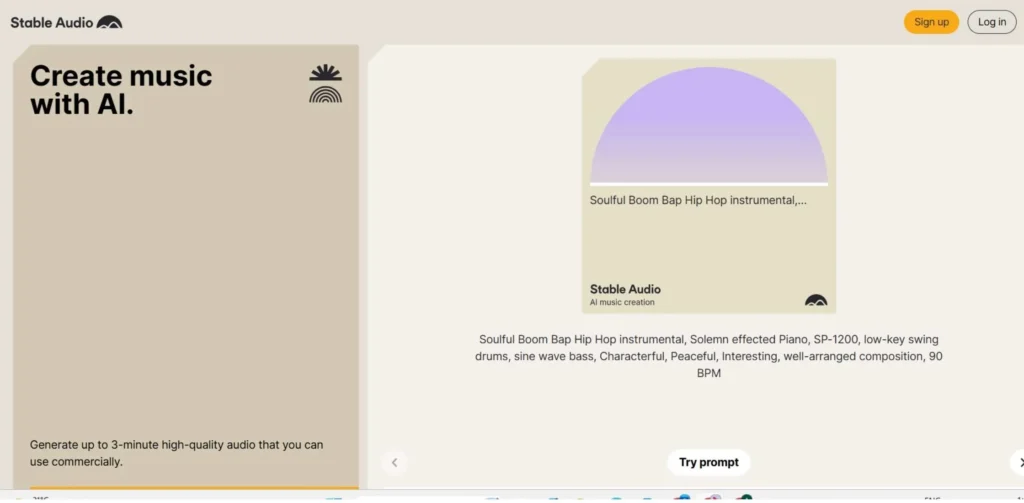
Stable Audio from Stability AI has a different approach compared to all the tools above. Unlike music compositions, Stable Audio excels in short audio clips or loops, ambient sounds, and sound effects. This would be good news for game developers and video creators.
Key Features:
- Best in Class Loop & Texture Generation
- Stable Audio Open – Open Source Version Available
- Good for: Drum Loops, One Shots, Ambient Textures
Pros and Cons of Stable Audio
Pros
- You can have an effortless music creation experience.
- Users can efficiently make AI-driven tracks.
- It has a complete personalization of mood, lyrics, and category.
Cons
- You need registration for further free credits.
Pricing:
Plan | Price | What You Get |
Free | $0 | 20 generations/month |
Pro | $11.99/month | More generations, longer clips |
Best For: Game Developers & Producers seeking raw audio ingredients rather than pre-produced songs.
11. MusicGen (Meta) — Best Open Source Option
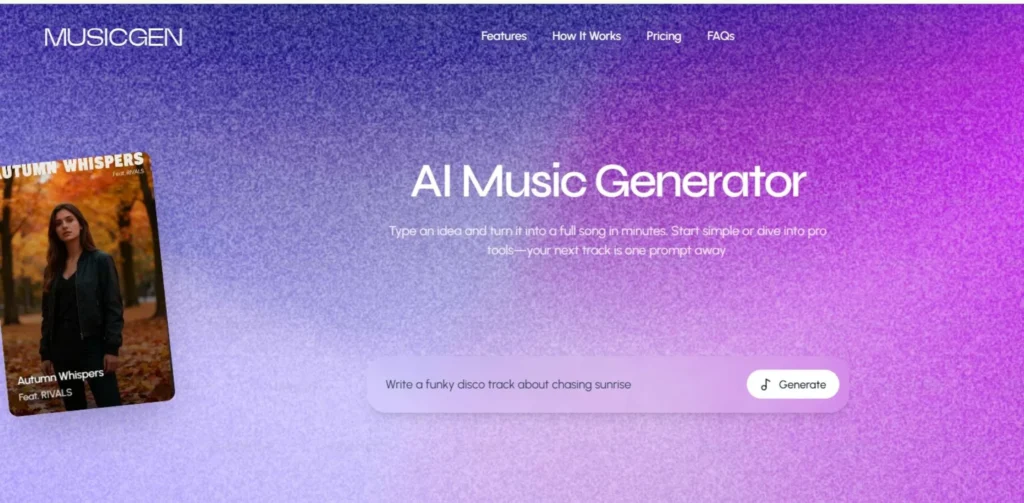
MusicGen is an open-source text-to-music model developed by Meta, part of their AudioCraft library. It is completely free, with no need to give credits or subscribe or deal with terms of service hassle. The only drawback is that it doesn’t support music with vocals; only instrumental music is supported. Also, some technical setup is required; there is no web interface.
Key Features:
- Run locally on your own hardware (16GB+ GPU recommended)
- Melody conditioning – hum a tune, and it expands on it
- MIT license allows for unrestricted use for commercial purposes
- Part of Meta’s AudioCraft research library
- Supports both 1.5B and 3.5B parameters
Pros And Cons of Jukebox
Pros
- The application has a wide category assistance that explores different categories, ranging that rock and modern pop to classical.
- The music platform is open-source.
- It can create complete songs as well as lyrics.
Cons
- It lacks a proper user interface.
- It generates music slowly.
- The platform has a low audio fidelity.
Pricing:
Free
Best For: Developers, researchers, and budget-conscious creators who want full control
12. Musicfy — Best for AI Vocal Covers

Musicfy is unlike most tools listed here. It’s not about background music. It’s all about AI vocals. You can create AI covers of songs using your voice or even text-to-music or the Text-to-Speech feature. Great for musicians who want to experiment with different vocal styles.
Another great alternative to Suno AI is the Musicfy generator. Just like the other music generators, it can also offer sufficient support for music production and features. Nonetheless, the application is famous for producing the user’s voice clone.
Furthermore, this music generator allows users to produce music with AI voices, and the best part is that these songs are mainly copyright-free and contain no royalties. Also, this music system implements a personalized AI figure integrating two contrasting voices to make a distinctive voice that no human has.
Key Features:
- AI Voice Cover with male/female options
- Text-to-speech and speech-to-speech conversion
- Vocal Reference for Guidance
- Royalty-free Output with paid plans
Pros And Cons of Musicfy
Pros
- It has a user-friendly interface.
- You can clone with an AI voice.
- Users have the capability for text-to-music conversion.
Cons
- It produces low-quality music.
- You cannot access your music without the internet.
- It has a restricted category versatility.
Pricing:
Plan | Price | What You Get |
Free | $0 | 3 generations |
Starter | $9/month | More generations |
Pro | $25/month | Custom voices + full features |
Best For: Musicians/Vocal Artists looking to explore the possibilities of AI-created Singing Voice and Vocal Styles.
13. ACE-Step v1.5 — Best Open Source for Full Songs
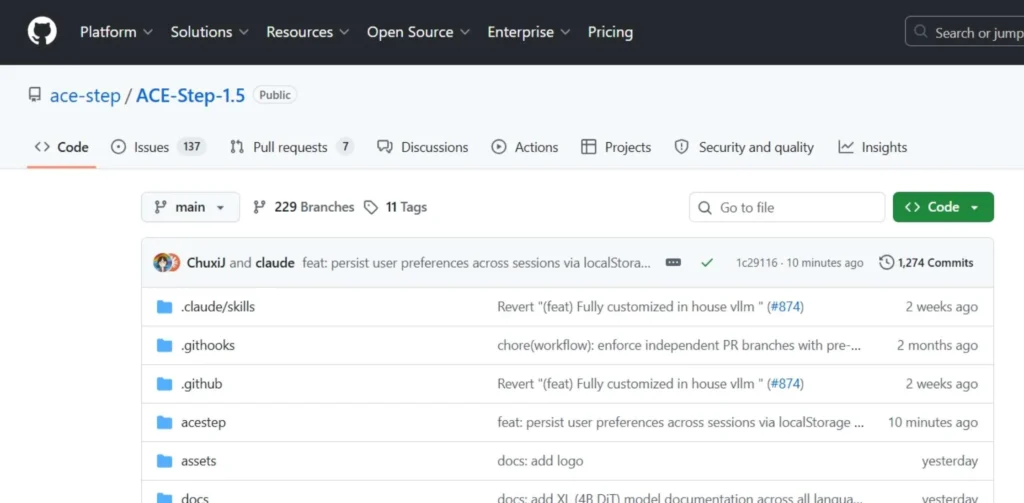
ACE-Step v1.5 was launched in April 2026. It is one of the most exciting open-source music models out there right now. It can create a full song of 4 minutes in under 10 seconds using an RTX 3090. It can create the same in under 2 seconds using an A100. It requires less than 4GB VRAM.
ACE-Step can create full songs with lyrics and vocals. It is not restricted to instrumentals like MusicGen.
Key Features:
- ACE-Step is based on the 4B parameter XL model (with xl-base, xl-sft, xl-turbo variants)
- ACE-Step can create full songs with the help of the provided lyrics and style prompts.
- ACE-Step can be fine-tuned using the LoRA model with the help of just a few songs to match your style.
- ACE-Step can be used with Mac, AMD, Intel, and CUDA devices.
- ACE-Step is one of the fastest open-source music models ever benchmarked.
Pros And Cons of Songstarter
Pros
- It has a convenient interface for most people.
- The music generator provides a lot of personalization features.
- You can produce royalty-free songs.
Cons
- It has restricted control for users.
- The application depends on an internet connection.
- The music generator has a basic music library.
Pricing:
Free. It is an open-source music model.
Best For: ACE-Step is best for developers who need the full Suno-like music model without a subscription, using their own devices.
14. Google Lyria — Best Audio Fidelity
Google really got into the AI music business in 2025-2026 with Lyria 3. This has real-time streaming of instrumental music via WebSocket, called Lyria RealTime. The quality of sound is the highest among all music tools. The potential for use in games and apps for music adaptation is very exciting. Just imagine music that changes beats per minute based on your running speed.
Key Features:
- Highest audio fidelity of any music model tested
- Lyria RealTime – Real-time adaptive music via WebSocket
- Singing capabilities were added in 2026
Pros And Cons of Google Lyria
Pros
- It can produce high-quality music.
- The music generator is open-source.
- It has a user-friendly interface.
Cons
- The music generator takes a lot of effort to run.
- It has restricted pre-trained figures.
- You might face probable compatibility problems.
Pricing:
API-only. There is no free consumer plan as of early 2026.
Best For: Fitness apps, games, and meditation tools. Backed by Google DeepMind
15. Mureka — Best for Lyrics-First Workflow
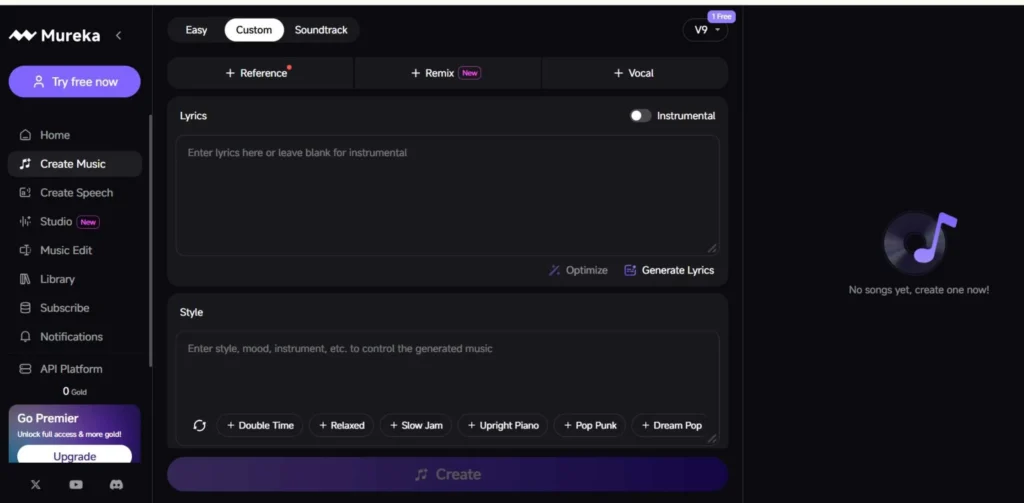
At the end of our list, we suggest the Mureka is for those who have their lyrics ready and want a great song created around them. Unlike other AI music generators that require you to fit your lyrics into their predetermined structure, Mureka will actually honor your verse-chorus-verse-chorus song structure with matching music phrases. Also included are Stem Separation, Instrumental Music Generation, and Podcast Mode.
Tool is is for those people who want an AI assistant that would help them compose music without any money. Nonetheless, with this music generator, you can do music formation, chord progression, and AI-oriented melodies.
Key Features:
- Works with your lyrics first
- Honors your song structure
- Incorporates Stem Separation
- Generates instrumental music
- Works closely with Suno to match your lyrics to your vocal melody
Pros And Cons of Mureka
Pros
- You can instantly generate new music.
- It has a mobile-friendly interface.
- Users have a lot of personalization options.
Cons
- You have restricted lyrics support.
- It lacks the emotional depth in its music.
- This is not a budget-friendly music generator.
Best For: Those songwriters who have their lyrics ready and want the AI music generator to create music around their lyrics instead of having to fit their lyrics into predetermined music phrases.
Best Free Suno AI Alternatives
If budget is the concern, these tools offer the most for the least, requiring your credit card for nothing:
Udio – 600 Free generations/month (capped at 10/day).
Best Free Tool with Vocals.
- Boomy – Unlimited song creations on the Free Plan.
- Perfect for Beginners.
- MusicGen – Fully Open Source. Zero usage limitations. No UI. Fully Free.
- ACE-Step – Open Source Local Model. Consumer-grade hardware requirements (under 4GB VRAM).
Open Source Suno AI Alternatives
For Developers, Researchers, or those seeking complete control without subscriptions or fees:
- MusicGen (Meta / AudioCraft) – Open Source. MIT License. Local usage. Ideal for instrumental music.
- ACE-Step v1.5 – Local music model. Generates a 4-minute song in less than 10 seconds on NVIDIA RTX 3090.
- Stable Audio Open – Best for loops, textures, and sound design (not songs).
- YuE AI – Vocals and Instruments from Lyrics. Supports multiple languages.
Best Suno AI Alternatives for Commercial Use
If you’re making content for YouTube, client work, or products, then commercial rights are the most important to you:
- ElevenLabs Music – Best commercial licensing rights; no ongoing legal issues
- Soundraw – Royalty-free forever if downloaded with any paid plan
- AIVA Pro – Complete copyright transfer to you (€33/month)
- Mubert – Official API + commercial licensing for businesses
Suno vs Udio vs Soundraw — Feature Comparison
| Feature | Suno AI | Udio | Soundraw |
|---|---|---|---|
| Type | Text to full song generator | Text to full song generator | AI music generator (no vocals) |
| Vocals | Yes (high-quality, polished) | Yes (expressive, realistic) | No vocals |
| Audio Quality | Very high (studio-ready) | Excellent (more organic) | Good (background music focused) |
| Genre Variety | Wide (Pop, EDM, Hip-hop) | Strong (Rock, Jazz, Acoustic) | Limited but customizable |
| Custom Lyrics | Yes | Yes | No |
| Song Length | Up to ~4 minutes | Up to ~3 minutes | Loop-based / adjustable |
| Control Level | Easy (beginner-friendly) | Advanced (more control) | Moderate (segment editing) |
| AI Style | Polished and commercial | Raw and artistic | Instrumental and royalty-free |
| Free Plan | Yes (credits-based) | Yes (limited tracks) | Limited trial |
| Commercial Use | Paid plan required | Paid plan required | Yes (subscription) |
| Best For | Content creators, YouTubers | Musicians, producers | Businesses, ads, background music |
Which Suno Alternative Is Best? — By Use Case
Finding the right choice for your Suno AI alternative will require you to have an overview of a comparative analysis. For instance, you will need to categorize each option with its benefits, and if you do that, you get:
- Do you need the best free tool with vocals? → Go with Udio (600 free generations/month)
- You’re a complete newbie? → Start with Boomy (unlimited free generation, 30-second songs)
- You’re creating content for YouTube/TikTok? → Go with Soundraw or Beatoven.ai (royalty-free, easy to sync with video)
- You’re a developer creating an app? → Go with ElevenLabs Music or Mubert (both have official APIs)
- Do you need orchestral/cinematic music? → Nothing beats AIVA (250+ styles, MIDI export)
- You need open-source with no costs, ever? → Go with MusicGen (instrumental) or ACE-Step (full songs)
- Do you need the cleanest commercial license? → ElevenLabs Music or Soundraw are your safest bets
- You already have your lyrics written? → Try Mureka, as it’s built specifically for this
Future of AI Music Tools — Market Insights
The figures here are something you should pay attention to if you make content for a living:
- The AI music generator market is currently at 1.98 billion in 2026 and will grow to 18.04 billion in 2035(CAGR: 28.5%)
- The cloud-based music generators have 74% of the market, while 26% are on-premise
- Currently, only 3% of music producers are utilizing AI for full-song creation, so there’s still a lot of room for growth
- Asia Pacific has ~25% of the market and is growing rapidly
- Warner Music has settled with Suno, and UMG has settled with Udio – the legal battle is dying down, and it’s great news for content creators
- Google’s Lyria RealTime is looking at the next big thing – real-time adaptive music in apps, games, and fitness tools
- Open-source music generators like ACE-Step v1.5 are catching up fast with commercial music generators – the 4B parameter XL version has just been released on April 2, 2026
In Conclusion
As we have mentioned, the top 15 best choices for Suno AI each offer their specialty to users. Furthermore, it also helps the users to select the right alternative following their music needs. Whether you want music for personal use or professional work, these top 15 choices can handle any of your music choices with specific requirements you want.
Moreover, the right choice also relies on your research for your professional requirements. Nonetheless, it does not matter what kind of AI system you use for producing music — even with the best Spotify alternatives, it is, moreover, next to impossible to produce precise human-like music.
FAQs
Does Suno AI have any comparative AI?
Yes, you can find a lot of music AIs that are similar to Suno, for example, Udio, Riffusion, Beatoven.ai, and many more.
Which is better between Suno and Udio?
Udio seems to be a better choice than Suno because it can deliver cleaner and higher-quality music compared to Suno.
Which is the best music AI generator you can use?
Although there is no single best music AI generator you can use, there are many better options such as Riffusion, Udio, Suno, and many others.
Do you need a paid subscription for Suno AI?
The Suno AI music generator provides both free and paid facilities for users who want to compose music.