Artificial intelligence moved from niche research to boardroom priority in a single funding cycle. AI firms captured 61% of all global venture-capital dollars in 2025, and investors pumped $202.3 billion into AI startups in 2025, a 75% year-over-year jump.
If you are building an applied-AI company—think computer-vision for warehouses or predictive maintenance for factories—you need investors who understand more than flashy demos.
The list below spotlights ten venture capital firms that consistently write checks for practical AI outside the Big-Tech halo.
List of Best Venture Capital Firms That Invest in AI
1. BonfireVentures
Los Angeles–based BonfireVentures is a seed-stage specialist that lives and breathes B2B SaaS—exactly where most applied-AI startups sit.
The partnership is stacked with former operators who have built and sold software companies, so diligence meetings quickly cut to go-to-market weak spots rather than vanity metrics.
- Typical first check: US$2 million–US$4 million with healthy reserves for follow-ons.
- Portfolio proof: Topline Pro, Risotto, and Calmwave all weave machine-learning into vertical SaaS and scaled revenue post-investment.
- Hands-on help: Hands-on, personalized support, and often advises founders on go-to-market strategy.
- Geography: U.S. focus, but remote-first teams with U.S. beach-heads are welcome.
Founders building AI that quietly powers business workflows—rather than consumer-facing gimmicks—should keep Bonfire at the top of their outreach list.
2. Radical Ventures

Toronto and San Francisco anchor Radical Ventures, a US$1 billion platform created expressly for deep-tech AI. Close ties to the Vector Institute and University of Toronto feed a pipeline of research-grade talent.
- Ticket size: US$5 million–US$15 million seed through Series B.
- Technical depth: Partners include computer-vision pioneers and neuroscience PhDs.
- Portfolio: Cohere, Waabi, Untether AI.
- Value-add: Access to proprietary compute discounts via hyperscaler alliances.
If your roadmap contains transformer models or custom silicon, Radical’s bench of scientists can spot and resource bottlenecks months before they blow budgets.
3. Air Street Capital
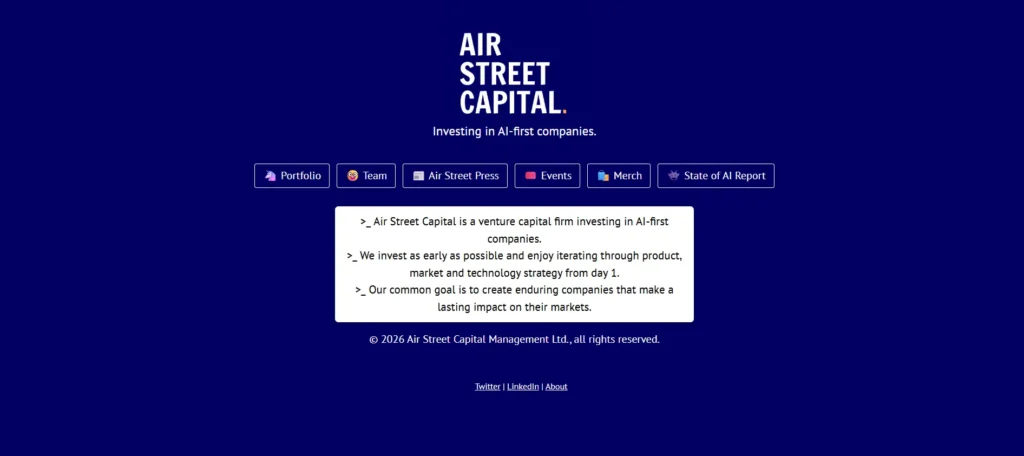
London-born Air Street Capital brands itself simply: “AI-first.” That clarity shows in a portfolio where 90% of companies monetize machine learning at their core.
- Check range: US$1 million–US$3 million pre-seed and seed.
- Community: Publishes the widely read State of AI report, giving founders instant visibility.
- Cross-Atlantic reach: Offices in London and New York ease U.S.–EU expansion.
- Sector picks: Life sciences, industrial automation, and security.
Air Street is ideal for technical founders who want a data-driven sounding board but also need practical intros to Series A growth funds on both sides of the pond.
4. Sapphire Ventures

Once SAP’s corporate-venturing arm, Sapphire Ventures is now an independent growth-stage powerhouse with US$10 billion AUM.
- Stage: Series B to Series D, checks from US$25 million to US$100 million.
- AI thesis: Infrastructure (vector databases, MLOps) and vertical apps with clear enterprise ROI.
- Distribution muscle: 100-plus Global 2000 CIO relationships speed large-deal pilots.
- Recent win: Led Series C in DataRobot long before AutoML became table stakes.
If you are scaling ARR past US$10 million and need customers more than cash, Sapphire’s customer-development team can open doors that few funds match.
5. Menlo Ventures
Multi-stage stalwart Menlo Ventures wrote the 2025 Enterprise Generative AI report that estimated enterprise-AI revenue tripled to US$37 billion in 2025. They back that research with capital.
- Fund size: US$1.8 billion for the latest flagship.
- Stage flexibility: Seed program (US$1 million) to late-stage growth (US$50 million+).
- Portfolio: Abnormal Security, Clarifai, Pinecone.
- Builder tools: Dedicated talent and marketing teams plus an in-house UX lab.
Menlo suits founders who want one cap-table name able to follow from the first prototype to the IPO roadshow.
6. Lux Capital
If your AI touches atoms—robotics, space tech, computational biology—Lux Capital probably has a thesis memo on it.
- Cheque size: US$3 million–US$20 million across stages.
- Edge conviction: Backed Anduril and Shield AI when defense tech was contrarian.
- AI/compute focus: Invests heavily in custom hardware and edge-AI.
- Resources: Story-crafting team turns complex tech into crisp narratives for non-technical buyers.
Lux is a fit when your AI needs expensive sensors, labs, or regulatory navigation that scares off purely software funds.
7. Insight Partners

New-York giant Insight Partners built its brand on later-stage SaaS but now operates a dedicated AI Growth Fund.
- Capital: US$30 million–US$200 million checks plus secondary liquidity.
- ScaleUp engine: On-site operators in product, sales, and finance embed for 100-day sprints.
- Global eye: 45% of portfolio sits outside North America.
- Mega-round data: 58% of all $500 million+ rounds in 2025 went to AI companies.
If you need to double headcount this year without torching culture, Insight’s ScaleUp squad is hard to beat.
8. EQT Ventures
Nordic-rooted EQT Ventures wields a €2.3 billion fund but still behaves like an agile seed outfit.
- Machine-learning inside: Its proprietary deal-sourcing AI “Motherbrain” surfaces under-networked founders.
- Ticket sizes: €1 million seed to €50 million Series C.
- Portfolio: Einride (autonomous freight), Peltarion, Natural Cycles.
- Platform: Access to EQT’s private-equity stable for later-stage capital.
European founders seeking patient capital with a seamless bridge to PE ownership often land here.
9. Lightspeed Venture Partners

Across Menlo Park, Bengaluru, and Tel Aviv, Lightspeed led several of 2025’s largest AI rounds—including a US$1 billion slug into Scale AI.
- Fund family: Global platform exceeds US$25 billion AUM.
- Stages: Seed dedication via LSIP, then growth funds for Series B+.
- Sector breadth: Enterprise software, healthtech, consumer social with generative-AI augmentations.
- Talent network: Portfolio access to elite recruiters who filled 2 000+ C-suite roles last year.
Lightspeed is the rare fund that can price your seed note and syndicate a US$500 million Series F if lightning strikes.
10. Georgian
Toronto-based Georgian takes a thesis-driven approach: they invest where they can add AI, security, and product-led growth playbooks through an internal R&D team.
- Stage: Series A–C, typical check US$20 million.
- Platform: In-house “Impact Team” ships reusable code—think privacy layers or RL-based pricing modules.
- Community: Private Slack of 100+ CTOs swapping models and benchmarks.
- Success story: Early backer of Kobo and Benevity.
Founders who want more commits to their GitHub than their board deck will appreciate Georgian’s engineer-heavy culture.
The Bigger Picture
The U.S. still hogs the bulk of money—79% of 2025 AI funding flowed to U.S-based companies, with the Bay Area alone pulling in US$122 billion. Yet demand for applied AI is global. Meanwhile, enterprise-AI revenue hit US$37 billion in 2025, more than triple that of 2024.
And remember, 58% of all $500 million+ startup mega-rounds last year went to AI.
Translation: Capital is abundant but concentrated, so positioning and proof points matter more than ever.
How to Shortlist the Right Investor
- Sector fit: Does the partner’s last fund include companies solving adjacent problems?
- Partner chemistry: You will spend 7–10 years together—reference-check portfolio CEOs.
- Post-investment support: Ask for concrete examples (first sales VP hire, acceleration of SOC 2 audit).
- Valuation sanity: A sky-high seed cap can block downstream rounds.
- Board bandwidth: Ensure your lead will take the seat, not a junior associate.
[Need inspiration? Check out AskDaman’s business ideas section.]
Conclusion
The AI funding wave is real, but securing the right dollars beats grabbing the fastest term sheet. Start refining your narrative, metrics, and moat now so these ten funds see a de-risked, execution-ready story.